What Board Training Misses

Every governance course teaches what a board should know. No one teaches cognitive diversity, or how to design a decision room with science behind it. Walk into an MBA classroom or a director-readiness program and you will find a thorough syllabus. Finance. Strategy. Risk. Legal duties. Stakeholder management. Students leave able to read a balance sheet, interrogate a strategy, and name their fiduciary obligations. They are taught what a competent board should know.
There is one thing the syllabus rarely touches, and it is one of the most important: cognitive diversity, and how to design the room where a group of capable people actually makes a decision together.
The gap hiding in plain sight
Board education is built around composition. Get the right skills around the table — finance here, legal there, industry experience in the corner — and good governance is meant to follow. The skills matrix has become the central artefact of board design.
A skills matrix tells you who is in the room. It says nothing about how that room decides.
Two boards with identical skills matrices can make decisions in completely different ways. One surfaces disagreement early and uses it. The other drifts toward the loudest voice and calls the silence consensus. The difference is not in the credentials. It is in the pattern of thinking the group falls into when the stakes rise — and that pattern is exactly what standard training leaves out.
Why it matters more than it looks
The research here is not soft. Work on cognitive diversity in decision-making links the mix of thinking styles in a group directly to the quality of its decisions. Balancing those styles has been associated with a 30% reduction in decision errors and a 20% lift in innovation (Bourke).
Those are not numbers about who is in the room. They are numbers about how the room works. When challenge is structurally absent — when no one in the group is wired to question the obvious path or sit with the uncomfortable option — the board does not feel the gap. It simply makes narrower decisions and never sees what it missed.
This is the part that should unsettle anyone training future directors. A board can pass every governance check, satisfy every independence requirement, and still decide badly, because the one layer that most directly predicts decision failure is the one no review process examines.

The harder the decision, the more the mix matters
Scott Page’s work sharpens the point. He shows that teams of genuinely different thinkers outperform homogeneous ones on complex tasks, producing what he calls diversity bonuses — better problem-solving, more innovation, more accurate judgement. His central finding is that these bonuses grow larger as the task grows harder. A board’s decisions sit at the complex, consequential end of that spectrum, which is exactly where the mix of thinking pays off most.
The catch is that the bonus is not automatic. Diversity for its own sake does not deliver it; the room has to be composed with intent. As Page puts it, “effective diverse teams are built with forethought.” Not all teams of rivals succeed. That is the whole argument for treating a decision room as something to design with evidence, rather than a mix left to chance.
What we would include in board training
Not in place of finance and strategy — alongside them. Give the people who will sit on tomorrow's boards a way to see the thing the matrix hides:
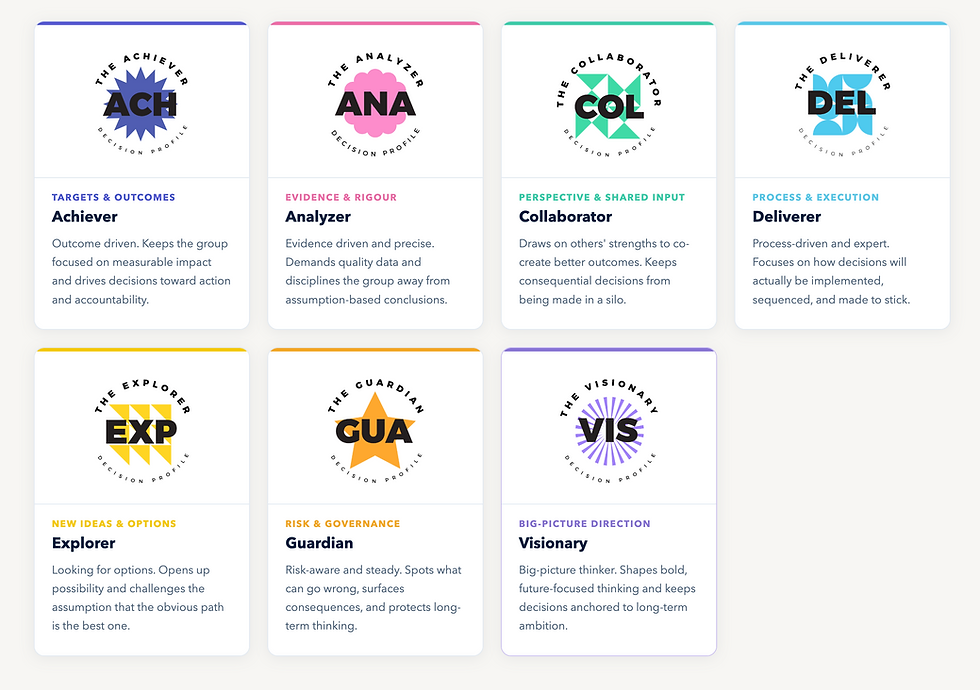
How they each decide. There are seven recognisable decision archetypes. Knowing your own is the first time many people see their default in plain view.
How a group decides together. Map a team and the collective pattern appears: which thinking leads, which is missing, where challenge is unlikely to come from.
What happens under pressure. The balance that looks healthy in a calm room often collapses toward a single style when the stakes rise. That shift is teachable, and visible, before it costs anything.
A student who learns to read a decision room carries that lens into every board and executive team they ever join. It is, quietly, one of the most durable things a program can hand them.

The point
Boards do not usually fail because the wrong people were in the room. They fail because the right people decided the wrong way and nobody could see the pattern in time.
Governance and board training teaches the room. The next layer is teaching cognitive diversity, and how to design the room with science behind it. That is the gap — and it is a teachable one.
Wizer is a decision intelligence platform built on peer-reviewed research. See how boards are mapping the decision layer at wizer.business/tools/board-decision-profiling.