Decision Intelligence: The Practice Your Organisation Has Never Named

Not a tool. Not a framework. A practice. And once you see the gap, you cannot unsee it.
There is a discipline missing from organisations. Strong ones have a strategy function. A finance function. An HR function. A communications function. They have people whose job it is to think about where the organisation is going, whether the numbers add up, whether the right talent sits in the right roles, and whether the message is landing.
What few organisations have is a function — or even a practice — dedicated to how decisions actually get made.
Not which decisions. Not the outcomes of decisions. How they happen. Who shapes them. Whose thinking dominates. Whose thinking is structurally absent. Whether the group making the call has the cognitive range the problem actually requires.
That gap has a name. It is called decision intelligence. And it is the practice that separates organisations that make consistently better decisions from organisations that keep making the same mistakes with different people in the room.
Decision intelligence is the practice. Decision science is the research it draws on — the work of Juliet Bourke, Scott Page and James Surowiecki on how groups make better decisions than individuals when their thinking is genuinely diverse. Wizer turns that science into something you can see and use in the room.
The meeting that keeps failing
You have been in this meeting. The proposal is strong. The evidence is clear. The logic holds. And yet the conversation goes sideways at the same point it always does — one voice dominates, the room narrows, and by the time you leave, you have made a smaller decision than the one you came in to make.
The post-mortem blames process. Or personality. Or politics. These explanations are not wrong. But they are incomplete. They describe the symptom. They do not name the mechanism.
The mechanism is cognitive composition. The group in that room had a thinking landscape — certain styles dominant, certain styles absent — and that landscape shaped the outcome before anyone said a word. The question that went unasked beforehand was: does the cognitive composition of this group match the decision we are about to make?
The question that went unasked before the meeting was: does the cognitive composition of this group match the decision we are about to make?

What decision intelligence actually is
Decision intelligence is not a personality assessment. It is not a leadership programme. It is not a governance framework.
It is the practice of making a group’s decision-making landscape visible — and using that visibility to change how decisions get made, not just who attends.
The distinction matters. Organisations often try to improve their decisions by changing who is in the room. More diversity. More representation. More voices. These are not bad instincts. But they treat decision quality as a headcount problem when it is a cognitive composition problem. You can change everyone in the room and still end up with the same thinking — because no one mapped how the new group actually decides.
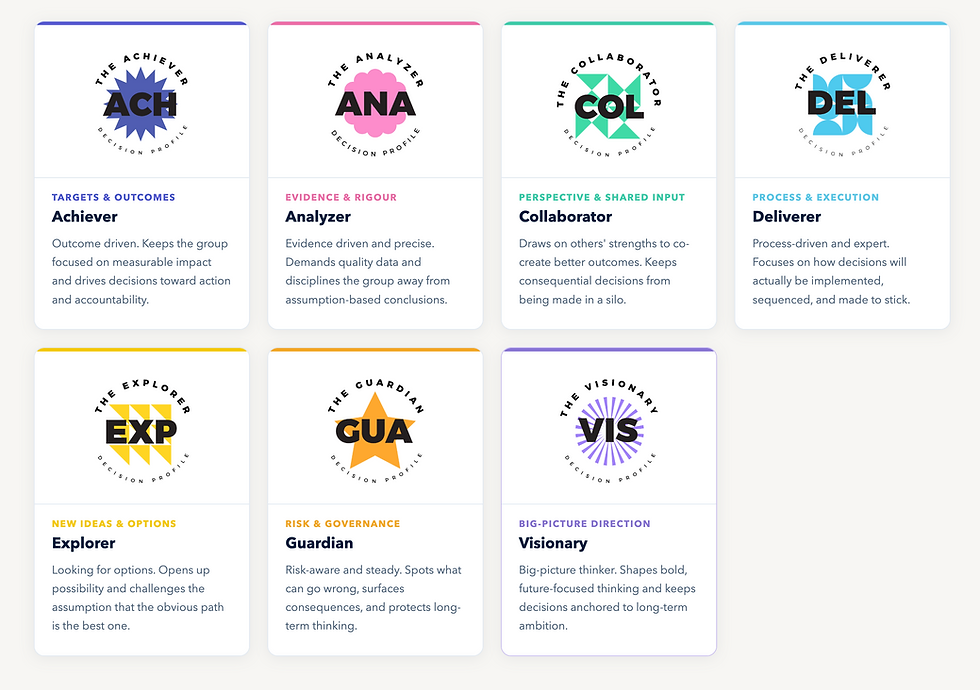
Decision intelligence starts one step earlier. Before you design the team, the panel, the board, or the governance structure — what thinking does this decision actually require? And then: who has it? And then: how do you reach each of them in the way they are most likely to hear you?
Why this is a practice, not a product
Disciplines that matter in an organisation tend to start as a practice before they become a function. Finance was once informal bookkeeping. Strategy was once a conversation in a boardroom. HR was once personnel administration.
Decision intelligence is at that early stage. Organisations rarely have a word for it yet. They describe the symptoms — groupthink, dominant voices, stalled initiatives, governance failures — without naming the underlying practice that addresses all of them.
That is what makes this moment interesting. The organisations that name it first — that build the practice before their peers do — will make better decisions during a window in which decisions are harder than ever to get right. More complexity. More uncertainty. More pressure to move fast and be right at the same time.
The research is not ambiguous on what the practice delivers. Dr Juliet Bourke’s work across more than 200 global organisations links cognitive diversity in a decision-making group to a 30 percent reduction in decision errors and a 20 percent increase in innovation — not because diverse groups are smarter, but because they are structurally less likely to miss what a homogeneous group would filter out.
Cognitive diversity in a decision-making group links to a 30 percent reduction in decision errors — not because diverse groups are smarter, but because they miss less.

The three questions the practice answers
Decision intelligence as a practice organises itself around three questions. They sound simple. Few organisations can answer any of them.
Who is actually making this decision? Not who is in the meeting. Not whose name is on the agenda. Who is shaping the outcome. Which voices carry weight. Which profiles dominate the thinking stage. Which perspectives are present at the table but absent from the decision.
Does the cognitive composition match the problem? A decision has a cognitive requirement. A decision about risk needs different thinking from a decision about innovation. A governance decision needs different thinking from an operational one. Groups are usually assembled by seniority or function, not by what the decision actually requires.
How do you reach each decision-maker in their own language? The CFO and the CPO process the same evidence differently. The proposal that energises one will stall with the other — not because of the content, but because of how it is framed. Decision intelligence makes the difference visible and gives you the tool to close it.
Where to start
The entry point is the same. One team. One decision. One question: whose thinking does this decision actually require, and do we have it in the room?
The answer to that question — made visible through Decision Profile Mapping — is the beginning of the practice. Not the end. A map of how a group decides is not a solution. It is the intelligence that makes the conversation that follows more likely to go the right way.
That is what a practice looks like. You build the capability. You use it before the decision, not after it fails. And over time, you get better at the thing that determines the quality of everything else you do.

Decision intelligence is not a Wizer idea. It is a discipline that exists whether you have a tool for it or not. The question for a leader is whether they are practising it deliberately or leaving it to chance.
Wizer is built to make the practice real. wizer.business