
Why capable boards make avoidable decisions
The answer is rarely about intent, information quality, or individual capability. It's about who shapes the framing of a problem — and whose challenge reaches the table once a direction starts to form.
Certain thinking styles dominate board discussions not because they're more correct, but because the conditions that allow other perspectives to land were never deliberately built. Risk profiles get overridden by execution instincts. Strategic challenge gets absorbed by consensus dynamics. Governance reviews, board evaluations, and regulatory remediation almost never examine this — because it's invisible from inside the room.
Board Decision Profiling examines the decision architecture. It's used alongside those other processes to identify what they miss.
WHAT THE PROFILING REVEALS
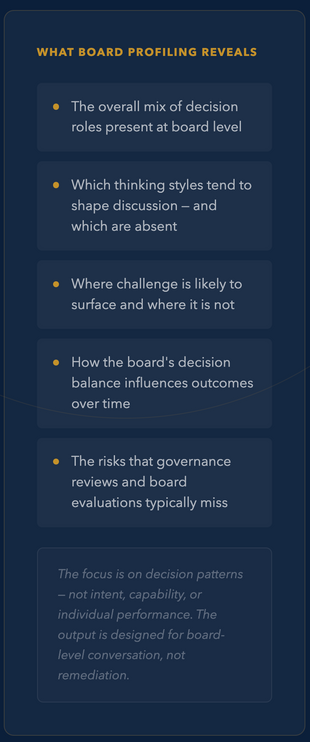
The decision patterns that governance reviews don't capture
Individual strengths interact in ways that are difficult to see from inside the room. Profiling makes those interactions visible — at the level of the group, not the individual.
01
Which decision roles dominate
Boards typically cluster in two or three thinking styles. That concentration shapes which problems get seen clearly, which risks get surfaced, and which alternatives never get considered.
02
Where challenge doesn't reach the table
The absence of certain profiles — particularly Guardian and Analyzer — creates conditions where challenge is structurally filtered out before it can influence an outcome, regardless of intent.
03
Why certain risks fail to escalate
When execution-focused profiles dominate, risk sensing is systematically underweight. Profiling shows where this pattern exists — before it contributes to a decision that shouldn't have been made.
04
How composition decisions compound over time
Boards tend to recruit in their own cognitive image — not deliberately, but because familiarity feels like alignment. Profiling shows where this drift has occurred and what it means for decision quality.
05
The gap between structure and behaviour
A board can have the right committees, the right charter, and the right skills matrix — and still have a decision architecture that systematically narrows outcomes. Those are different problems.
06
How to strengthen decision quality without assessment
The output is designed to improve how decisions are designed and structured going forward — not to evaluate what happened in the past or to prescribe personnel changes.
WHAT BOARDS RECEIVE
A clear, board-level output designed for serious discussion
All outputs are designed to be neutral, evidence-led, and appropriate for board use. Nothing is prescriptive. The value is in seeing the pattern — not being told what to do.
Individual Decision Profiles for each director
Each board member receives their own Decision Power Profile — showing how they engage with decisions, their strengths, and how their style interacts with others around the table.
Aggregated Board Decision Map
The full picture of how the board's thinking combines — showing the collective mix of profiles, which dominate, and which are structurally absent.
Board decision report
A concise, board-appropriate report outlining decision strengths, blind spots, and the structural conditions those patterns create for different types of decisions.
Optional facilitated walkthrough
Presentation-ready slides and facilitation support for boards that want to work through the findings together as a group discussion.
HOW BOARDS TYPICALLY USE THIS
DEVELOPING A SHARED
DECISION LANGUAGE
Creating common framing for how the board makes decisions — distinct from governance language or performance language.
UNDERSTANDING RECURRING ISSUES
Identifying why certain topics stall, certain risks don't escalate, or certain decisions get revisited repeatedly.
SUCCESS AND
COMPOSITION
Informing decisions about board renewal and composition with evidence about what the board's decision architecture currently lacks.
ALONGSIDE GOVERNANCE
REVIEWS
Used as a complement to formal board evaluations and regulatory remediation to surface what those processes miss.
HOW IT WORKS
Designed to be efficient and appropriate for board-level use
1
2
3
Individual profiles
Aggregated board map
Design better decision rooms
Each director completes a Decision Profile assessment independently — around four minutes. Results are confidential to the individual.
Wizer produces the aggregated Board Decision Map and report — showing the collective picture without identifying individual responses.
Use live recommendations to build the right mix of thinking into every decision that matters — and track the strength of those panels over time.
Recommended Reading
Looking for a deeper dive into the science of smarter decisions?
Dr Juliet Bourke’s Which Two Heads Are Better Than One? is a landmark book showing how cognitive diversity reduces errors by 30% and lifts innovation by 20%.
Once sold by the AICD for $50, it’s now exclusively available through Wizer for just $24.99 + postage.
