Decision Profile Mapping: Turning Insights Into Better Decisions
- Kylee Ingram
- Oct 7, 2025
- 2 min read

Every organisation talks about better decision-making, but few can explain how their decisions actually get made. Who’s in the room? Which perspectives dominate? Which are missing?
Most leaders assume that bringing smart people together is enough. In practice, many decisions fail because the mix of voices isn’t right — too much similarity, too little independence, and not enough visibility into the thinking behind the outcome.
That’s where Decision Profile Mapping comes in.
What Decision Profile Mapping Is
Decision Profile Mapping connects how people think with how decisions are made. It shows the balance of thinking styles, experience, and diversity shaping a decision — and the gaps that might quietly distort it.
At Wizer, we built this process from years of research into decision science, leadership psychology, and the “wise crowd” effect. The idea is simple: when you can see the dynamics driving a decision, you can improve it before it happens.
How It Works
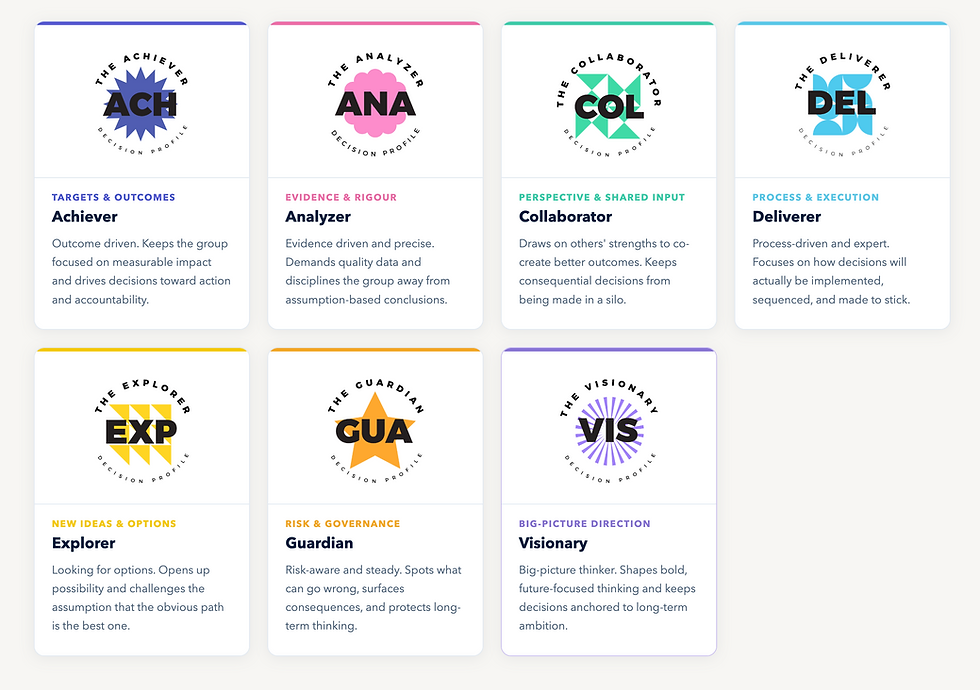
Profiles: Everyone completes their Decision Profile — a short evidence-based assessment revealing how they approach decisions (outcomes, evidence, people, risk, etc.).
Mapping: For any given decision, Wizer maps those profiles against the required balance of perspectives.
Analysis: The platform identifies missing archetypes, experience types, or demographic diversity.
Action: Leaders adjust the decision group, add missing voices, or change the process before bias or blind spots take hold.
It’s decision intelligence made practical — a live view of who is shaping the outcome and how that mix can be strengthened.

Why It Matters
Research across leadership and organisational psychology is clear:
Diversity of thought improves outcomes.
Independent judgment reduces bias.
Aggregating varied perspectives produces more accurate decisions.
But most organisations don’t have the tools to measure or manage those dynamics. Decision Profile Mapping closes that gap — combining the structure of decision mapping with real data about the people involved.
The result isn’t more meetings. It’s better ones — where leaders know who’s in the room, who’s missing, and why that matters.
Outcomes
When organisations use Decision Profile Mapping, they:• Reduce bias and groupthink before it skews results• Increase engagement and ownership in decisions• Discover hidden talent and under-represented perspectives• Improve decision speed and quality• Build lasting organisational intelligence
Try It for Yourself
Decision Profile Mapping is available inside Wizer — you can see how your organisation’s mix of thinking styles shapes outcomes and where gaps might exist.
If you’d like to understand the full science behind decision mapping, we’ve also created an easy step-by-step guide you can follow here: 👉 Decision Mapping: A Practical Guide to Better Decisions