

What Makes a Decision Defensible?

When a decision goes badly, the first question asked is rarely "was this the right call?" It is almost always: how did we get here?
Leaders who can answer that question — who was involved, what they each brought, what evidence was considered, and where the gaps were visible before the decision locked in — are in a fundamentally different position from those who can't.
Defensible decisions are not ones that always succeed. They are ones where you can show your work.
Defensibility Is a Process Standard, Not a Retrospective Exercise
The term gets misused. In practice, defensibility tends to get treated as something you construct after a decision is challenged — a narrative that explains why it made sense at the time.
A defensible decision is one where the process was sound before the outcome was known. The right perspectives were in the room, the relevant evidence was surfaced and weighed, and the gaps in the panel's thinking were identified — not discovered after the fact.
A defensible decision can still produce a poor outcome. Decisions are made under uncertainty and no process eliminates that. What defensibility establishes is that the conditions for good judgement were deliberately created — that the decision wasn't left to whoever happened to be available, whoever held the most status, or whoever spoke loudest.
That distinction matters. Regulators, boards, and stakeholders increasingly expect process transparency alongside results. The question is no longer only "what did you decide?" — it is "how, and with whom?"

Three Structural Forces That Quietly Undermine Decision Accountability
Decision processes erode in predictable ways. Decision science identifies three structural forces that compound over time, often without leaders noticing them.
Social bias is the pull toward familiar voices. When decisions are shaped by whoever holds the most seniority or social capital in the room, the panel reflects power rather than perspective. The people best placed to identify a blind spot may exist in the organisation — and be absent from the conversation.
Information bias is the tendency to weight evidence that confirms existing views and underweight evidence that challenges them. Under time pressure, this becomes more acute. The information treated as credible is often the information that fits the dominant narrative — not necessarily the most relevant evidence for the decision at hand.
Capacity bias operates under pressure, when cognitive load pushes groups toward the familiar. This is when oversimplification happens — when nuance gets cut, alternatives collapse, and the decision narrows before it needs to. Predictably, this also tends to be when the quality of the decision matters most.
These forces do not announce themselves. They are not failures of intelligence or intent. They are structural — which means they require structural responses.
What the Research Shows
Dr. Juliet Bourke's research on inclusive leadership found that when groups approach problems with a genuine range of thinking styles, represented and weighted with reasonable equality, decision error rates fall by approximately 30%. That figure comes from field research across organisations, not from theory.
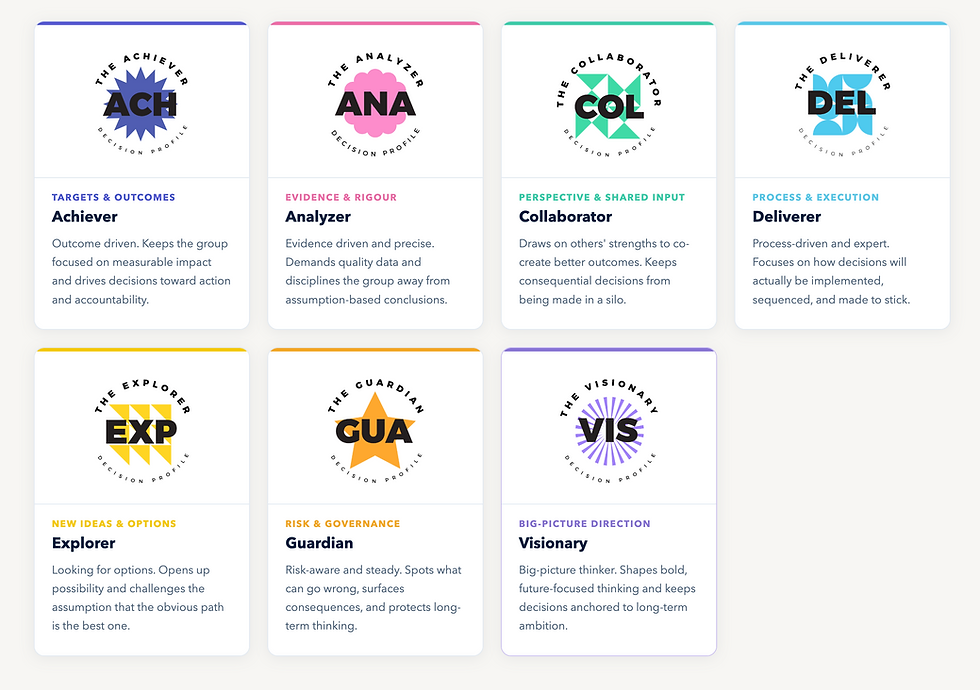
Her research also identified the mechanism behind the erosion. As leadership habits form, people mirror the dominant thinking styles of those around and above them. Achiever and Visionary profiles accumulate at the top of organisations. Evidence, process, and people perspectives get progressively underweighted. The organisation believes it is deciding well — and quietly replicates the same errors, cycle after cycle.
Capability and cognitive diversity are not the same thing. A panel that looks strong on paper can still be structurally narrow.
What a Defensible Decision Process Looks Like
A defensible decision process has three visible properties.
The panel is deliberate. The people involved were chosen because of what they bring to this specific decision — not because of proximity, habit, or hierarchy. Someone asked, explicitly, whether the right mix of thinking was in the room before the decision was made.
The gaps were identified before the decision locked in. Research on decision quality shows that 40–60% of the strongest contributors to a given decision are not in the room where that decision happens — not because they don't exist in the organisation, but because they haven't been surfaced. Panel Strength analysis makes that identification possible before the meeting, not after the review.
The process is auditable. Someone could reconstruct, after the fact, what was considered, who raised what, and what was set aside and why. This is not documentation for its own sake — it is the basis on which a leadership team can stand behind a decision when it is scrutinised.
The Practical Starting Point
Understanding the cognitive landscape of your leadership team is the foundation. Decision Profile Mapping makes visible what is present, what is dominant, and what is missing — across individuals, teams, and the organisation. Panel Strength scoring lets you assess the composition of a decision group before it convenes. The recommendation engine surfaces the people whose thinking is most needed for a specific decision, regardless of where they sit in a hierarchy.
None of this replaces human judgement. It is the structural support for it — the condition-setting that makes good judgement more likely, and the process visible when it counts.
The question is not whether you made the right call. The question is whether you built the conditions to make a good one — and whether you can show it.
Wizer is a decision intelligence platform that helps organisations see how decisions are shaped — by thinking, experience, and perspective. Learn more at wizer.business


