

The 5-Minute Meeting Prep That Changes Everything - Knowing Their Decision Profiles

Updated: Jan 5
How understanding decision profiles helps you walk into every conversation better prepared
Most client managers prepare for important meetings the same way: review the account history, check the latest emails, maybe rehearse your key points.
But great client managers add one more step: they think about the person's decision profile.
A decision profile is simply how someone naturally approaches decisions - what they pay attention to, what worries them, what makes them say yes. Some people focus on outcomes and speed. Others need to see all the risks addressed first. Some care most about people impact. Others want evidence and logic they can trust.
When you understand someone's decision profile, you stop guessing how to frame your message. You know.
Here are the 5 questions that help you use decision profiles to prepare for any high-stakes conversation.
1. What decision profile am I walking into?
Before you write that email or walk into that meeting, the smartest thing you can do is ask: How does this person naturally make decisions?
Are they a "let's move fast" type who wants clear outcomes and timelines? Or someone who slows down to think through risks and safeguards? Do they care most about people and relationships, or data and evidence? Do they want one clear recommendation, or do they need to see all the options?
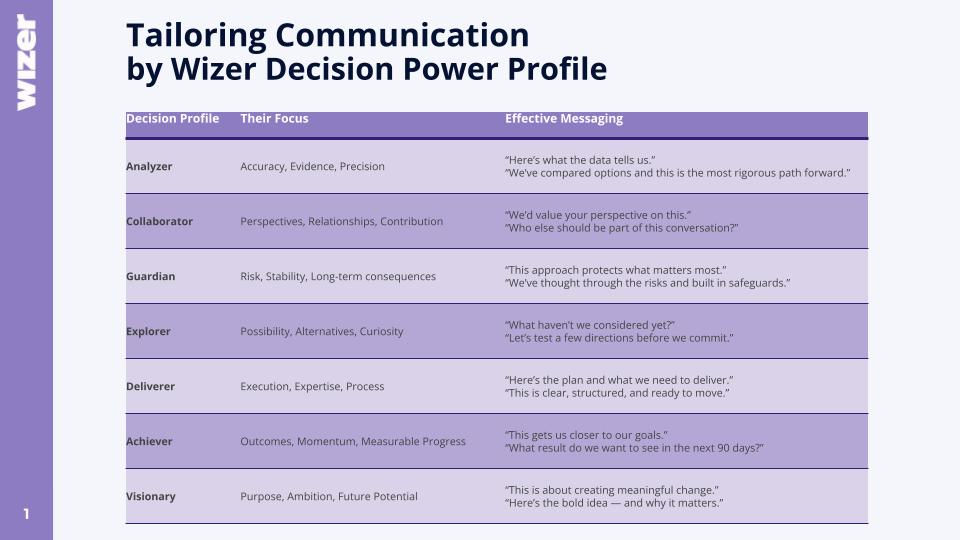
Common decision profiles you'll encounter:
Achievers respond to clear outcomes, timelines, and ownership. They want to know what success looks like and when we'll get there.
Guardians relax when you front-load risk mitigation. They're not blocking progress - they're protecting it. Address concerns early.
Visionaries engage when they see the bigger story and future upside. They want to understand the "why" and the potential.
Collaborators care about people impact and shared process. They want to know who's affected and how we'll work together.
Analyzers need evidence and logic they can trust. Show your working. Back up claims with data.
Explorers like to see options, scenarios, and room to shape the solution. Don't box them in too early.
Deliverers focus on practicality and execution. They want to know it will actually work in the real world.
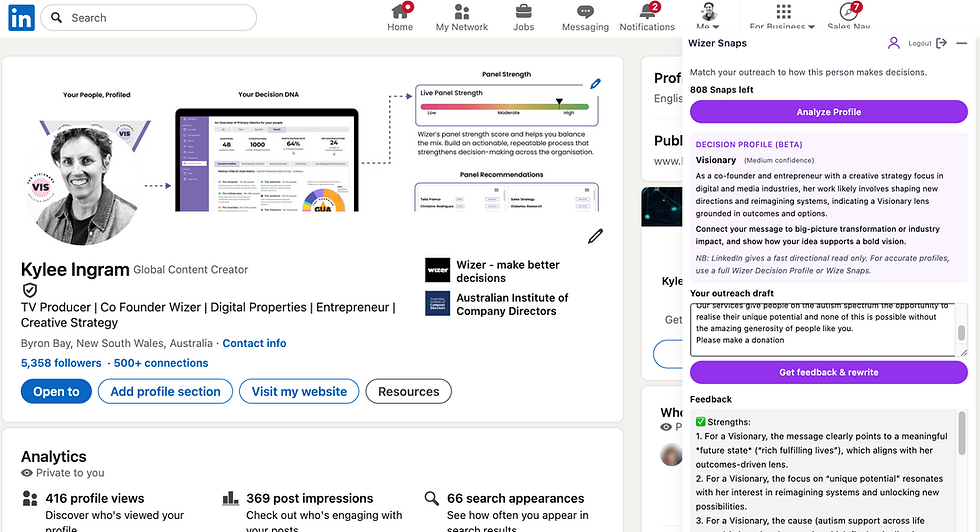
The fastest way to get a read on someone's decision profile? Check their LinkedIn with Wize Snaps - it analyzes their profile and gives you their likely decision style in about 15 seconds.

2. Am I framing my ask in their language?
Here's what most people miss: it's not just what you're proposing. It's how you frame it.
The same proposal can land completely differently depending on whether you're talking to an Achiever or a Guardian, a Visionary or an Analyzer.
Example: You're proposing a new project approach
To an Achiever: "This will cut delivery time by three weeks and give us a clear milestone every Friday."
To a Guardian: "Before we commit, here's how we've de-risked the three main concerns from last time."
To a Visionary: "This positions us ahead of where the market's heading and opens up two new opportunities."
To a Collaborator: "The team's genuinely excited about this, and it solves the pain point Sarah flagged last month."
To an Analyzer: "The data from the pilot shows a 23% improvement, and here's why that's replicable."
Same project. Five different entry points. Each one lands because it matches how that person naturally evaluates decisions.
When you frame your ask in someone's decision language, they don't just understand you. They feel understood. That's when trust builds.
For a deeper look at why this matters, we explored this in detail here: Why Some Asks Land and Others Don't - the Role of Decision Style.
3. Am I falling into the AI template trap?
We've all used AI writing tools. They're fast, they're helpful, and they can definitely save time and they help your email read well.
But here's the problem: most AI tools make one fatal assumption.
They assume the person reading your message thinks like you. Or worse, like some imaginary "average" decision maker.
That's fine for high-volume, low-stakes messages. It's terrible for:
A tense renewal conversation
A donor you can't afford to lose
A stakeholder who's been blocking progress
A board member you need onside for a big decision
These moments live in a slower, more human space. You aren't sending 1,000 emails. You're trying to get one specific person to genuinely understand, trust, and say yes.
The fix: After you draft with AI (or write it yourself), read it back through the lens of their decision profile. Does this actually speak to what they care about? Or does it just sound professionally polite?
If you want to understand why generic messages feel wrong - especially AI-generated ones - we unpacked this here: Every AI Writing Tool Makes the Same Fatal Assumption.
4. Where will this person likely push back?
Every client manager has had this experience:
You think you've covered everything. The proposal is solid. The deck is polished.
Then one question derails the whole conversation.
The frustrating part? It's often predictable.
Once you understand someone's decision profile, you can see the pushback coming:
Guardians will ask: "What if this goes wrong? What's our backup plan?"
Achievers will ask: "When exactly will we see results? Who owns what?"
Collaborators will ask: "How will this affect the team? Have we consulted the right people?"
Analyzers will ask: "Where's the evidence for this claim? How do we know this is the best option?"
Visionaries will ask: "Does this move us forward strategically, or are we just patching a problem?"
Explorers will ask: "Have we considered alternatives? What if we tried X instead?"
Deliverers will ask: "Will this actually work in practice? What are the implementation risks?"
This isn't about them being difficult. It's about their decision profile making certain concerns non-negotiable. When you address these concerns upfront - before they even ask - the conversation shifts from defense to collaboration.
We wrote more about this dynamic here: How to Work with Difficult People.
5. What's my one clear ask?
This is the question most people skip - and it's why so many well-intentioned messages go nowhere.
After all the context, all the background, all the detail... what is the single thing you need this person to understand, agree to, or do?
Not three things. Not "just keeping you updated." One clear ask.
Examples of clear asks:
"Can you approve the Q1 budget by Friday?"
"I need 30 minutes next week to walk through the revised proposal."
"Will you sponsor this initiative at the board meeting?"
"Can you introduce me to the decision maker on their team?"
Why this matters for decision profiles:
Different profiles respond to clarity differently. Achievers and Deliverers appreciate directness. Guardians and Analyzers want to know exactly what they're committing to. Collaborators want to understand how their "yes" helps others. Visionaries want to see how this ask fits the bigger picture.
But all of them - all of them - respond better when you're clear about what you're actually asking for.
Putting it together: Your 5-minute meeting prep ritual
Here's how to use this before your next important conversation:
Step 1: Look up the key person on LinkedIn (or review past interactions)
Step 2: Identify their likely decision profile - or use Wize Snaps to get a read in 15 seconds
Step 3: Ask yourself:
What are they most likely worried about?
What will "success" look like from their perspective?
What language are they likely to respond to?
Step 4: Draft your key message or ask in their style, not yours
Step 5: Sanity-check - does this still feel honest and accurate to you?
That's it. Five minutes. But repeated across a year of renewals, fee conversations, and project pitches, it quietly compounds into something more valuable: trust.
Decision profiles: people skills, but with better data
At its core, understanding decision profiles isn't about manipulation or sales tactics.
It's about helping good client managers do what they already know matters: really listen to how someone thinks, and adjust your approach accordingly.
Nothing says "I'm listening" like actually taking in how someone makes decisions.
If your work lives in that slower, higher-stakes space - key clients, major donors, senior stakeholders, strategic partners - then decision profiles aren't a "nice to have."
They're part of how you show you're paying attention.
Want to try this in practice? Wize Snaps is a Chrome extension that profiles decision styles from LinkedIn in about 15 seconds. It's designed for exactly these moments - when the message really matters, and you want to get it right the first time. OR Wize Snaps at https://www.wizer.business/commsmatching

