

Why Some Asks Land — and Others Don’t: The Role of Decision Style

The Ask Isn’t Always the Problem You can have the right message, the right data, and the right timing—and still get silence. A polite no. Or a decision that never comes.
If you’re leading, fundraising, managing stakeholders, or driving change, you’ve likely felt this. You ask clearly and reasonably. You explain your thinking. But something doesn’t land.
Here’s the hard truth: the real issue often isn’t what you’re asking. It’s how the person you’re speaking to makes decisions. Understanding that one shift can change how you communicate—and how effective you are.
Why Decision-Making Styles Matter
When someone receives a request—whether to donate, join a project, approve a plan, or support a direction—they subconsciously run it through a decision-making filter. And not everyone uses the same filter.
Some people need evidence. Others focus on risk. Some want to know the goal. Others want to know who else is involved.
What persuades one person might feel irrelevant—or even off-putting—to another.
Too often, we assume others decide like we do. That assumption can stall decisions, break trust, or waste time.
The Research Behind It: Different Styles, Different Decisions
Dr Juliet Bourke’s foundational research identified six key thinking styles that shape how people contribute to decisions: outcomes, options, people, process, evidence, and risk. These styles affect what people notice, what they value, and what they dismiss.
At Wizer, we built on this research to develop seven Decision Power Profiles. These profiles don’t measure personality—they uncover how someone approaches a decision, especially under pressure.
The seven profiles are:
Analyzer – Data-driven, precise, and focused on accuracy.
Collaborator – Relationship-oriented, sees value in others’ perspectives, and brings people into the process to shape outcomes together.
Guardian – Risk-aware, ensuring stability and long-term thinking.
Explorer – Open to possibilities, always surfacing new options.
Deliverer – Process-driven, excelling in deep expertise and execution.
Achiever – Goal-focused and prioritises outcomes.
Visionary – Big-picture thinker, shaping bold, future-focused ideas.
Each profile brings value. Each one also requires different messaging to move from insight to action.

What Happens When the Message Doesn’t Match Picture this:
You send a detailed data report to someone who thinks in terms of purpose and vision. It feels cold or uninspiring.
You present a high-level idea to a Guardian. It feels vague and risky.
You give a go/no-go task to an Explorer. It feels restrictive and premature.
It’s not that the ask was wrong—it was misaligned with how that person decides.
This misalignment can cause delays, disengagement, or a complete lack of follow-up.
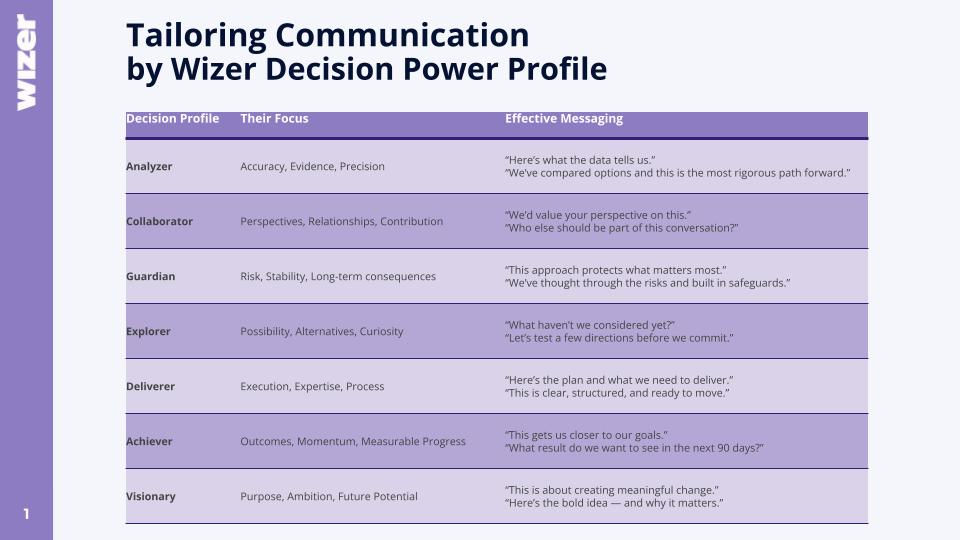
How to Tailor Communication by Decision Profile
When you understand someone’s Decision Power Profile, you can adapt your message to meet them where they are.
Why This Matters in Real Life
Leaders trying to get buy-in. Fundraisers looking for aligned benefactors. Consultants designing change programs.
They’re all facing the same challenge: knowing what to say, and how to say it so it lands.
Understanding decision profiles isn’t a communication trick. It’s about respecting how others think, and adapting so we reduce resistance and increase connection.
What Wizer Offers
Wizer helps organisations identify the decision styles across their teams, stakeholders, or supporters. We then show how to adjust communication and participation strategies to reduce friction and improve results.
We don’t offer static reports. We offer live recommendations, dynamic insights, and the ability to build smarter decision-making systems.
Conclusion: It’s Not About Changing How You Communicate. It’s About Understanding How They Decide.
If you’ve ever felt like your message isn’t landing—this is probably why.
Once you understand how someone processes decisions, everything changes. You stop pushing harder. You start communicating smarter.
That’s the power of decision science in action.
Curious about your own Decision Profile?
Take the free test here: https://www.wizer.business/decision-profiles

