Why Most Outreach Fails and What to Do About It

Outreach is broken.
Not because it’s dead. Not because no one reads email anymore.
But because it’s become an arms race, and we’ve lost sight of what really drives action.
The Outreach Arms Race
Across sectors, from startups to social enterprises, the pressure is the same: reach more people, with fewer resources, and somehow drive better results.
Email remains the workhorse. For donor engagement, sales, research, partnerships…it’s still the default channel. And so teams spin up dozens of versions. Ten, twenty, even more. Sequenced, A/B tested, multichannel. Hundreds of variants in play, tweaked and tailored to maximize response.
And yet, most of those efforts don’t land and the stats paint a bleak picture:
The average response rate for cold outreach emails is just 1–5%.
Even “high-performing” campaigns rarely crack 20%.
Most companies run 4–7-message sequences just to squeeze out basic traction.
And sales reps spend 21% of their day just writing and managing emails.
This isn’t strategic. It’s survival mode.The entire outreach stack - HubSpot. Salesloft. Mailchimp. Apollo. Lemlist. AI-assisted writers - is designed to send more messages, faster, and make them look personal.
But more versions aren’t the answer.Smarter ones are.
The “Personalisation” Mirage
The default personalization playbook is wearing thin.
Insert name. Mention company. Reference a recent event or shared interest.
It’s not bad. In fact, it’s better than nothing. But it rarely lands as genuine. More often, it feels like a tactic.
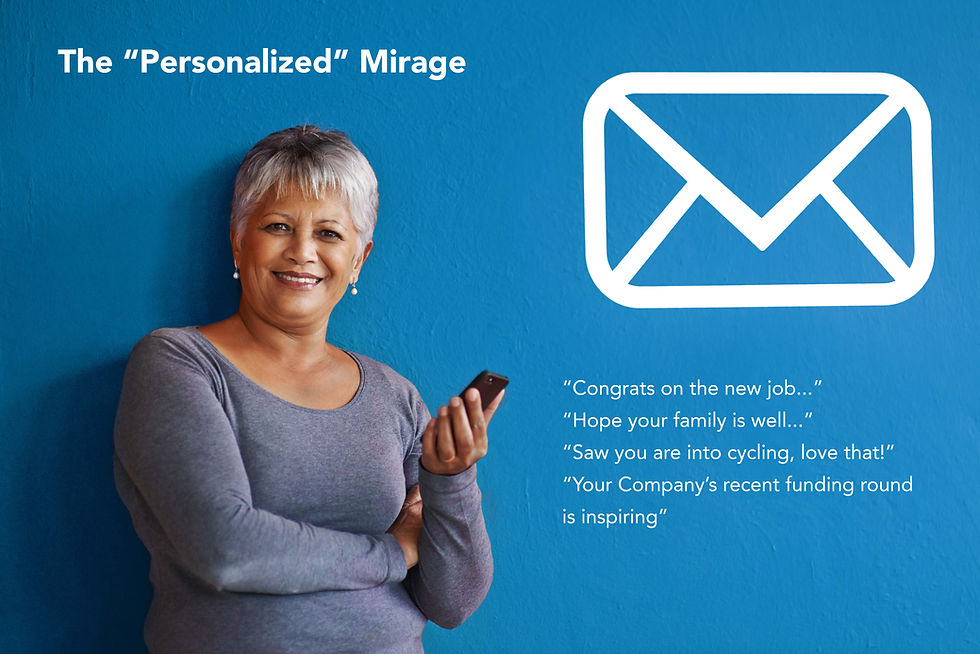
We've all seen the awkward first lines:“Saw you’re into cycling, love that!”“Congrats on the new role!”“Your company’s recent funding round is inspiring!”
That’s surface-level personalization. It signals effort, not understanding.
And that’s the real problem: 👉 Do you understand how this person makes decisions?
The Missing Layer: Decision Style
Most outreach strategies assume decision-making is linear:
Show value → Earn response.
But decades of behavioral science say otherwise.
People respond based on how they process information, not just what information you give them.
Psychologists like Daniel Kahneman and thinkers like Lisa Lahey and Dr Julia Bourke have shown that decision-making is driven by cognitive style as much as rational logic.
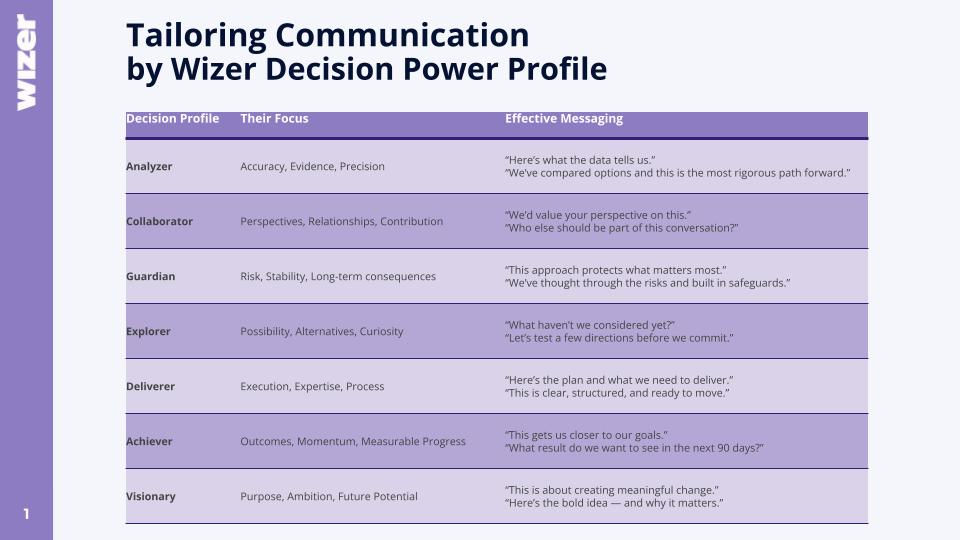
A Guardian wants security and reassurance.
A Visionary needs to imagine what’s possible.
An Analyzer looks for proof and data.
A Collaborator seeks shared value and alignment.
If you ignore this, you can write the “perfect” email and still get nothing back.
Because to the wrong mind, the right message looks like noise.

Why This Matters for NFPs and Customer Discovery
This isn’t just a sales problem.
For not-for-profits, every donor interaction counts. You don’t get infinite tries. Shallow outreach doesn’t just fail, it can damage trust.
In customer discovery, it’s even more critical. You’re not trying to sell, you’re trying to learn. But if your ask doesn’t align with how someone decides what to engage with, you won’t get insight, you’ll get silence.
In both cases, it’s not about more emails.
It’s about the right ones.
A Better Way: Decision-Aware Outreach
Here’s where things start to shift.
New tools, like Wizer, are flipping the script. Instead of guessing or generalizing, they use decision science to map cognitive styles and guide messaging accordingly.
Wizer identifies seven core decision profiles.With that lens, your outreach isn't just “more personalized”, it’s more effective.
You stop writing 20 generic templates for titles like “CEO” or “Marketing Director” and instead write 4 high-impact messages tailored to actual decision-making behavior.
It’s not about replacing your marketing team.It’s about giving them a smarter foundation.
The Takeaway
Outreach has become a volume game. More versions. More automation. More noise. But until you factor in how people decide - not just who they are - you’re playing blind.
The next leap isn’t AI-generated icebreakers or faster sequences. It’s understanding the mind on the other side of the message and shaping communication accordingly.
Outreach is still powerful. But only when it speaks to the way people choose.
If you’re serious about levelling up outreach, whether for fundraising, sales, research, or partnerships, this is the shift to make.
Not more gimmicks.Not more versions.Just better decisions.
Curious what decision-aware outreach could look like for your team? Check out how Wizer maps decision profiles to messaging strategies. → Link in comments
First Comment: https://www.wizer.business/commsmatching