

Live Practice + Shadowing
Sales in Motion
Live Practice & Shadowing
The outcome of this section is to:
-
See how others pitch, how leads react, what lands
-
Targeted outreach using Wizer tone and triggers
-
Practice your first pitch
-
Start with your first outreach and review
Below is a little about the process and some of the materials you will see in the pitch
The Usual Flow of a Wizer Sale
While the steps below outline a typical flow for a Wizer sale, every conversation is different — and so are the people we’re speaking with.
As we mentioned your first meeting should all be about discovery. Understand the clients problems and challenges. What are they doing now - if anything to address the challenges. From that discovery call you will be able to produce the deck below - including use cases and also the set up for the demo.
You can find your First Call Discovery questions in this document.
At any stage, a partner or client might ask to “see what this looks like.” This is completely normal. Always be ready with:
-
Your Wizer deck
-
The live Wizer platform open and ready to share
Here is the Deck
-
This is the generic deck for stakeholder engagement (we have another for team optimisation) we usually adapt for clients. It is good to have made if you are pitching to a client.
-
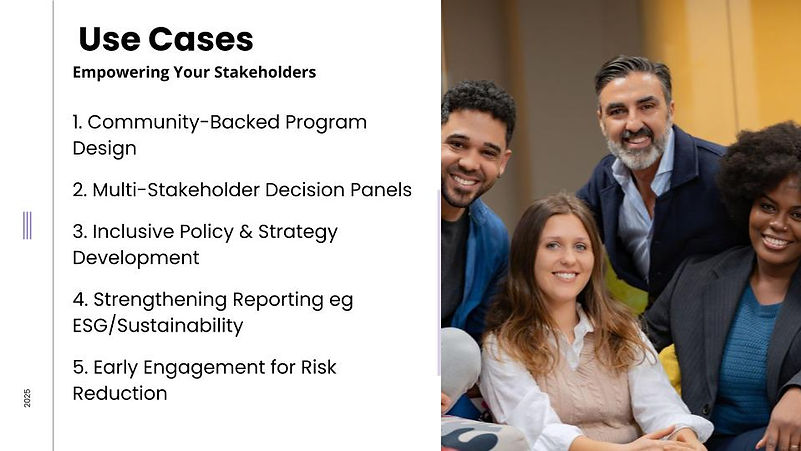
Often the Use Case slide is the slide I use most
Here is the Use Case Slide:
What Does a Typical Stakeholder Engagement Sales Flow Look Like?
Wizer works best when paired with purpose. Many of our most successful partnerships start with people already trusted in their industry — whether it’s someone like Tranby, leading Indigenous engagement, or BaptistCare, focused on aged care. These partners don’t just run one-off projects. They build ongoing engagement models for clients using Wizer as the backbone.
These are often trusted, mission-driven groups that already have deep relationships within a community or vertical. They’re looking for a better way to run engagement: more transparent, inclusive, and scalable. Wizer helps them turn that trust into an offering they can build a business around.
It is also fine to find clients who just want to use it for their own purposes.
1. Identify the Right Type of Organization
You're looking for leaders in a space who are already doing engagement but need a better system.
Strong candidates often include:
-
Indigenous organizations already facilitating community consultation (like Tranby)
-
Aged care providers doing resident and family engagement (like BaptistCare)
-
Disability advocacy groups, DEI specialists, or local councils
-
NGOs or social enterprises wanting to offer structured consultation to government or corporates
They don't need convincing that engagement matters — they need a platform that makes it easier, smarter, and more valuable.
These are great examples of large channel partners who may be able to help their industry with research but we also want to find clients who can use this in their own businesses.
2. Open the Conversation
Start by asking about their current process for stakeholder engagement:
-
Who do they listen to?
-
How do they gather input?
-
How do they know when they’ve heard from the right people?
Listen deeply. Then introduce Wizer as a way to support what they already do — not replace it.
You can show the platform if asked. Be ready to demonstrate how it:
-
Structures stakeholders into panels
-
Makes live recommendations on who’s missing
-
Provides a transparent record of insights and inclusion
3. Share the Intention and Propose a Pilot
Let them know that the best way to get started is with a single decision or engagement.
Keep it simple:
“We’d love to help you structure one engagement using Wizer — and see if it’s something you could help with your most "recent decision or process" with your stakeholders.
You can follow up with a short deck or overview of what a pilot would involve. This should be tailored to their space (aged care, Indigenous engagement, etc.) and show how Wizer fits what they already do.
4. Design the Pilot Together
You don’t need to overcomplicate it. The pilot should answer these six questions:
-
What is the core decision or issue you're engaging stakeholders on?
-
What outcome would make this pilot a success?
-
Who’s involved — both inside your organization and in the community?
-
What’s the timeline?
-
What does success look like — speed, inclusion, trust, clarity?
-
What role will Wizer play, and what will your team lead?
Make the funding model clear and fair — it should show commitment but not create friction. In some cases, this may be funded by a third party (e.g. government or industry sponsor).
5. Support and Deliver
Once agreed, Wizer will help you:
-
Set up your stakeholder groups
-
Provide templates and guides
-
Deliver the engagement with clear reporting and data
After that, the real opportunity begins — turning a single pilot into a repeatable, revenue-generating offer that sets a new standard in your sector.