

Why Boards Fail: Board Decision-Making and Cognitive Diversity

Updated: Jan 12
Boards rarely perform below their best, or even fail, due to lack of experience.
In fact, many of the most visible corporate failures of the past few decades were overseen by boards filled with highly credentialed leaders — former CEOs, senior public servants, regulators, financiers, lawyers, and industry experts. Governance structures were in place. Committees existed. Risk registers were maintained. Assurance processes were followed.
Boards rarely function at a sub-optimal level, or even fail completely, due to a lack of cognitive diversity.
This is the paradox at the heart of modern board governance: how can well-qualified boards, operating within formal governance frameworks, repeatedly preside over decisions that unravel so publicly?
The answer is uncomfortable, but increasingly well supported by evidence. Board failure is rarely a skills problem. It is a decision-making problem — specifically, a failure to design for the right mix of thinking at the point decisions are made.
This is where the research of Dr Juliet Bourke becomes critical. Her work on cognitive diversity shows that decision quality depends not on intelligence or experience alone, but on whether different decision lenses are present, visible, and empowered — especially under pressure.
This article applies that research to four well-documented board failures:
Enron (collapse and fraud)
HIH (Australia’s most infamous corporate collapse)
Star Entertainment (governance drift and regulatory failure)
Boeing (737 MAX failures and safety consequences)
Different industries. Different eras. Different jurisdictions.
The same structural gaps.
What the science says about board decision-making
Cognitive diversity is often misunderstood as a softer cousin of demographic diversity. Dr Juliet Bourke’s research corrects that. Cognitive diversity is not about representation for its own sake. It is about how different kinds of thinking shape decisions, particularly when problems are complex, ambiguous, and high-stakes.
Her work highlights several patterns that are especially relevant at board level:
Groups default to familiar decision models under pressure
Confidence and coherence are often mistaken for rigour
Complexity encourages simplification, not deeper interrogation
Dissent is frequently individualised rather than structurally supported
Boards are particularly vulnerable because they operate at a distance from day-to-day operations. Information is summarised. Risk is abstracted. Decisions are episodic, but consequences are continuous.
When the mix of decision roles in the room is unbalanced, boards do not usually make one catastrophic decision. They make a series of defensible, incremental decisions that drift — until failure becomes unavoidable.
Decision quality depends not on intelligence or experience alone, but on whether different decision lenses are present, visible, and able to shape the outcome.
Cognitive diversity is not about having difference in the room; it is about whether different ways of thinking are structurally able to influence decisions.
Why traditional board governance misses decision failure
Most board assessments focus on structure:
independence
committee composition
skills matrices
attendance and engagement
compliance with governance codes
These matter. But they are insufficient.
They tell us who is in the room, not how the room thinks.
A board can satisfy every formal governance requirement and still lack the decision roles required to:
interrogate complexity,
reframe internal momentum,
elevate external consequence,
or interrupt performance pressure.
This gap explains why boards can be “renewed” without changing behaviour — and why regulators often find the same problems recurring even after intervention.
From theory to assessment: how this analysis was conducted
Method note
Historic boards cannot be interviewed or psychometrically assessed. However, board failures leave extensive public evidence:
inquiry findings and royal commissions
regulatory proceedings
court filings
company disclosures
biographies and public statements
repeated decision patterns and tolerances
For this analysis, Perplexity was used to collate and cross-reference third-party sources and to identify the core decision-makers during the relevant periods. We then applied the principles behind Wize Snaps to assess likely decision-role distributions within those cohorts.
This is not an assessment of individual intent, competence, or character. It is a pattern-based analysis of decision environments.
Decision roles and cognitive diversity (briefly)
Wize Snaps identifies seven recurring decision roles:
Achiever — performance, targets, momentum
Deliverer — execution and operational certainty
Guardian — risk, compliance, duty of care
Analyzer — evidence, interrogation, clarity
Explorer — external perspective, second-order consequences
Visionary — long-term framing and direction
Collaborator — perspective gathering and challenge
Boards do not need all seven in equal measure. They do need the right mix for the risks they face.
The four boards
1) Enron: brilliance without interruption

Context and established record
By the late 1990s, Enron had repositioned itself from a conventional energy business into a complex trading and financial engineering organisation. Its strategy relied heavily on mark-to-market accounting, special purpose entities, and off-balance-sheet structures to smooth earnings and sustain rapid growth.
The board overseeing this strategy was not inexperienced. It included senior academics in accounting and finance, former regulators, institutional leaders, and directors with deep exposure to capital markets. Formal governance mechanisms were in place, including audit and compliance committees, and external advisors were regularly engaged.
Despite this, the board repeatedly approved:
increasingly opaque financial structures,
expanded use of special purpose vehicles,
incentive systems tightly coupled to short-term performance,
and transactions that materially increased leverage and dependency on market confidence.
Concerns were raised internally and externally, but these did not translate into decisive strategic interruption. What happened
Enron collapsed in late 2001 after years of aggressive accounting practices, off-balance-sheet structures, and misleading disclosures that concealed mounting losses. Once confidence broke, the company unraveled rapidly, leading to bankruptcy, criminal convictions, and sweeping regulatory reform.
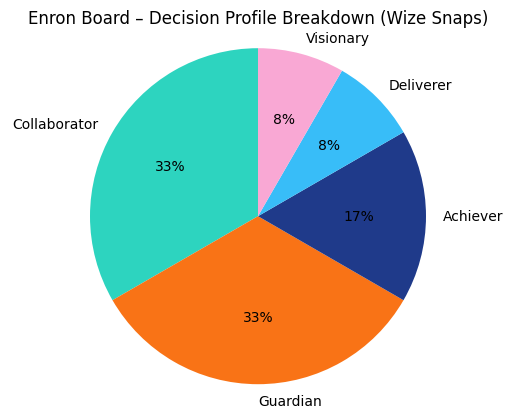
Decision Profile distribution (Wize Snaps)
Based on publicly identifiable decision-makers during the relevant period, the Enron board exhibited the following decision-role distribution:
Collaborator — 33%
Guardian — 33%
Achiever — 17%
Deliverer — 8%
Visionary — 8%
Analyzer — 0%
Explorer — 0%
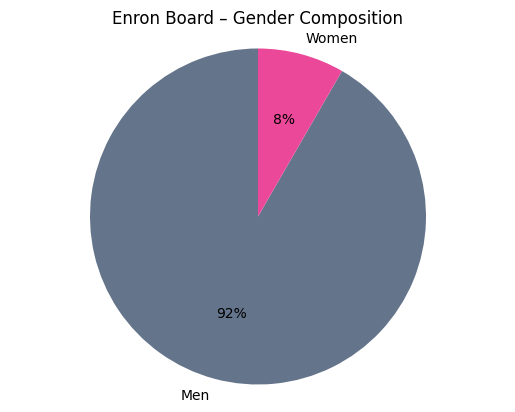
Enron's Board Gender composition
Men — ~92%
Women — ~8% (one woman)
What this pattern explains
At first glance, the presence of Guardian roles appears inconsistent with the scale of risk that ultimately materialised. Risk oversight structures existed. Compliance and audit processes were formally observed.|
The failure lies not in the absence of risk awareness, but in the absence of decision roles capable of converting risk awareness into interruption.
No Analyzer role existed with sufficient authority to reduce financial and structural complexity to plain-language truth: economic substance, downside exposure, and dependency on continuous confidence.
No Explorer role existed to reframe internally coherent strategies against external consequence: reputational collapse, market reaction, and systemic fragility.
The strong presence of Collaborator roles is also material. Collaboration supported cohesion and trust, but in a high-status environment it also reinforced deference to executive narratives and intellectual sophistication. Complexity became a signal of capability rather than a trigger for simplification.
This configuration explains how a board capable of detailed discussion and formal oversight could repeatedly approve decisions that increased fragility. Enron did not fail because no one cared about risk. It failed because no decision role was structurally positioned to force clarity or to stop momentum once complexity and confidence reinforced each other.
2) HIH: Governance Without Financial Clarity

Context and established record
HIH was once one of Australia’s largest insurers, operating across multiple jurisdictions and lines of business. Prior to its collapse, the company reported continued growth and maintained formal governance structures consistent with regulatory expectations.
The board included legal, commercial, and insurance expertise. Risk and compliance processes existed. External advisors were engaged. However, the organisation carried significant exposure to long-tail liabilities, reinsurance dependency, and aggressive expansion strategies that materially weakened its balance sheet.
The Royal Commission later found that the board relied heavily on management representations and failed to understand the true financial position of the company until collapse was imminent. What happened
HIH Insurance collapsed in 2001 after years of under-provisioning, aggressive expansion, and poor acquisition decisions that masked the true financial position of the company. The failure left policyholders exposed and triggered a Royal Commission into corporate governance and audit oversight in Australia.
Decision Profile distribution (Wize Snaps)
Based on the assessed cohort, the HIH board exhibited:
Guardian — 55%
Achiever — 18%
Collaborator — 18%
Deliverer — 9%
Analyzer — 0%
Explorer — 0%
Visionary — 0%

Gender composition
Men — 100%
Women — 0%

What this pattern explains
HIH is often described as a failure of governance. The decision-role distribution suggests something more specific: governance without clarity.
The dominance of Guardian roles created strong confidence in formal oversight — policies, controls, committees, and assurance mechanisms. Risk was monitored, documented, and discussed.
What was missing were the decision roles required to translate that oversight into understanding:
No Analyzer role existed to interrogate financial complexity, stress assumptions, and simplify solvency risk into unequivocal conclusions.
No Explorer role existed to reframe internal confidence against external realities such as market confidence, reinsurance exposure, and systemic fragility.
In this configuration, governance mechanisms can create a false sense of security. Risk is “managed” without being fully understood. Confidence in process substitutes for clarity about substance.
HIH did not collapse because risk was ignored. It collapsed because risk oversight was not matched by decision roles capable of forcing financial truth into the open early enough to alter course.
3) Star Entertainment: Performance Without Escalation (2017–2021)

Context and established record
During the period examined by the Bell Inquiry, Star Entertainment operated in a highly regulated environment with known exposure to money-laundering and criminal-association risks.
The board and senior leadership were repeatedly made aware of these risks through internal reporting, regulatory engagement, and external scrutiny. Remediation programs were initiated. Improvements were documented.
Despite this, the Bell Inquiry found that governance and risk management remained ineffective, with risks normalised over time and escalation delayed until regulatory intervention became unavoidable. What happened
Star Entertainment faced regulatory intervention following findings that it had facilitated money laundering, maintained inappropriate relationships with criminal figures, and failed to act on known compliance risks. Despite repeated warnings, governance failures persisted, resulting in inquiries, fines, and ongoing regulatory supervision.
Decision Profile distribution (Wize Snaps)
Based on the revised assessment of the core decision-making cohort during this period, the Star board exhibited:
Achiever — 57%
Guardian — 29%
Analyzer — 14%
Collaborator — 0%
Explorer — 0%
Visionary — 0%
Deliverer — 0%

Gender composition
Men — ~71%
Women — ~29%

What this pattern explains
An Achiever-dominant board is oriented toward continuity, performance, and maintaining operational momentum. Guardian roles ensure risks are identified and formally addressed. Analyzer presence supports technical assessment and reporting.
What is structurally missing is decisive escalation capacity:
No Explorer role to reframe regulatory and criminal-association risks as existential threats to licence and legitimacy rather than operational compliance issues.
No Collaborator role to strengthen collective challenge and prevent risk concerns from remaining isolated.
No Visionary role to elevate long-term licence-to-operate considerations above short-term remediation logic.
In this configuration, risks are acknowledged, documented, and managed — but rarely reclassified as requiring immediate interruption. This explains the Bell Inquiry’s findings of risk normalisation, delayed response, and governance that improved incrementally but failed to change trajectory.
Star’s failure was not ignorance or inaction. It was the absence of decision roles that force escalation when performance pressure and tolerance converge.
4) Boeing: performance pressure distortion

Context and established record
Boeing faced intense competitive pressure during the development and rollout of the 737 MAX, particularly in response to Airbus. Internal documentation and post-incident investigations revealed repeated engineering concerns, safety warnings, and design compromises intended to preserve delivery timelines and market position.
The board overseeing this period was experienced and well-credentialed, with formal risk oversight structures and safety reporting mechanisms in place.
Despite this, critical issues were not elevated or acted upon in ways that prevented catastrophic failure. What happened
Boeing’s 737 MAX program was implicated in two fatal crashes linked to design flaws, inadequate pilot disclosure, and internal decision-making that prioritised schedule and competitive pressure over safety escalation. The fallout led to global groundings, congressional inquiries, leadership changes, and lasting reputational damage.
Decision Profile distribution (Wize Snaps)
The Boeing board during the relevant period exhibited:
Achiever — 46%
Guardian — 31%
Collaborator — 15%
Deliverer — 8%
Analyzer — 0%
Explorer — 0%
Visionary — 0%

Gender composition
Men — ~77%
Women — ~23%

Gender composition (for the assessed cohort)
Men — ~77%
Women — ~23%
What this pattern explains
Achiever dominance frames decisions through performance urgency, competitive positioning, and delivery pressure. Guardian roles focus on regulatory compliance and formal safety oversight. Collaborator roles support cohesion and trust in executive assurances.
What is missing is again decisive:
No Analyzer role to translate technical complexity into clear board-level stop decisions.
No Explorer role to surface second-order consequences — reputational collapse, systemic trust erosion, and human cost — before failure occurred.
In this environment, safety becomes a compliance issue rather than a strategic interruption trigger. Performance momentum continues until external intervention forces a reset.
Boeing’s failure reflects not a lack of oversight, but the absence of decision roles capable of restraining achievement pressure when it conflicted with safety reality.
What these four boards tell us — when viewed together
Taken individually, each of these cases can be explained in familiar ways: fraud, governance failure, regulatory breach, competitive pressure, safety oversight. Those explanations are not wrong — but they are incomplete.
When viewed together through a decision-role lens, a clearer and more uncomfortable pattern emerges.
Across Enron, HIH, Star Entertainment, and Boeing, the same decision roles are consistently absent or structurally weakened, even though other forms of oversight appear strong. The missing roles differ in name, but not in function:
roles that force clarity when complexity increases, and
roles that reframe internal momentum against external consequence.
In every case, boards had access to information. In every case, risks were identified at some level. In every case, governance processes existed.
What failed was not awareness, but interruption. While the contexts differ, a consistent pattern emerges across Enron, HIH, Star Entertainment, and Boeing.
Decision roles associated with outward perspective — particularly Explorer and Visionary lenses — are either weak or structurally absent.
In each case, boards displayed strength in execution, cohesion, or internal risk awareness. What was limited was the capacity to reframe decisions against longer-term external consequence, systemic impact, or reputational exposure.
Why boards struggle to self-correct
Boards are not designed to surface disruptive decision roles naturally.
Analyzer and Explorer roles are cognitively demanding and socially uncomfortable. They slow discussion, challenge assumptions, and resist momentum — particularly momentum that appears to be working.
In high-status environments, these roles are easy to marginalise:
Analyzer challenge can be dismissed as excessive detail or second-guessing.
Explorer reframing can be treated as speculative or premature.
As pressure increases, boards tend to strengthen what they already value:
more reporting,
more governance,
more remediation,
more assurance.
What they rarely do is redesign how decisions are framed at the moment they matter.
This explains why boards can be renewed, refreshed, or reconstituted — and still drift in recognisable ways.
What this means for Chairs, regulators, and advisors
This analysis does not argue for more caution, more compliance, or more diversity in the abstract. Those prescriptions are too blunt to be effective.
It points to something narrower and more actionable:
Boards must be accountable not only for the decisions they make, but for the decision roles that were active — and inactive — when those decisions were framed.
For Chairs, this shifts the role from meeting management to decision architecture: ensuring that clarity and external consequence are structurally present, not dependent on individual courage.
For regulators, it suggests that structural reform alone is insufficient if cognitive imbalance remains unaddressed.
For advisors, it highlights the limits of skills matrices and independence tests that do not assess how thinking actually shows up under pressure.
From governance to decision accountability
Dr Bourke’s research explains why cognitive diversity matters. Decision-role analysis shows where it breaks down.
Together, they point to a practical conclusion:
Most board failures are not caused by missing information, but by missing interruption.
Boards that endure are not those with the most oversight mechanisms. They are those that make it impossible for complexity to hide, for momentum to go unchallenged, and for consequence to remain abstract.
That requires more than governance.
It requires decision accountability — an explicit understanding of how decisions are framed, challenged, and interrupted before failure makes those questions unavoidable.
An obvious next question is whether boards of long-term successful companies exhibit a different decision balance — particularly stronger Explorer or Visionary presence. That analysis sits outside the scope of this piece, but it is precisely the kind of pattern this approach is designed to surface.
A practical next step
The analysis in this article focuses on historic boards, using publicly available evidence to identify recurring decision-role gaps.
For current boards, this analysis can be done directly.
Decision-profile mapping makes it possible to:
see which decision roles consistently dominate board discussions,
identify which roles are structurally absent or overridden,
and understand how decision framing may shift under pressure.
This is not a replacement for governance review or skills assessment. It is a complementary lens that focuses on how decisions are actually made.
Boards, Chairs, and advisors interested in applying this lens to their own decision-making can do so through structured decision mapping.
Appendix A - The Boards who were assessed
The following boards and decision-making cohorts were assessed for this analysis. Cohorts reflect individuals publicly identified as holding primary decision-making responsibility during the relevant periods, based on inquiry findings, regulatory material, and contemporaneous reporting.
Enron (collapse and fraud)
Assessed board cohort:
Norman P. Blake Jr.
Ronnie C. Chan
John H. Duncan
Ken L. Harrison
Robert K. Jaedicke
Charles A. LeMaistre
John Mendelsohn
Jerome J. Meyer
Frank Savage
John Wakeham
Joe H. Foy
HIH Insurance (Australia’s most infamous corporate collapse)
Assessed board cohort:
Geoffrey Cohen
Ray Williams
Rodney Adler
Charles Abbott
Robert Stitt QC
Justin Gardener
Michael Payne
Alexander Gorrie
Neville Head
George Sturesteps
Star Entertainment Group (2017–2021) — governance drift and regulatory failure
Assessed decision-making cohort:
John O’Neill AO (Chair)
Matt Bekier (Managing Director & CEO)
Paula Martin (Chief Legal & Risk Officer / Company Secretary)
Harry Theodore (Chief Financial Officer)
Greg Hawkins (CEO, The Star Sydney)
Darren Ritonja (Chief Casino Officer, NSW)
Dr Sally Pitkin AO (Independent Non-Executive Director)
Boeing (737 MAX failures and safety consequences)
Assessed board cohort:
Dennis A. Muilenburg
David L. Calhoun
Kenneth M. Duberstein
Robert A. Bradway
Arthur D. Collins Jr.
Lynn J. Good
Edward M. Liddy
Lawrence W. Kellner
Caroline B. Kennedy
Susan C. Schwab
Ronald A. Williams
Mike S. Zafirovski
Nikki R. Haley

