

Decision Intelligence in Action: Three Ways Organisations Are Transforming Outcomes

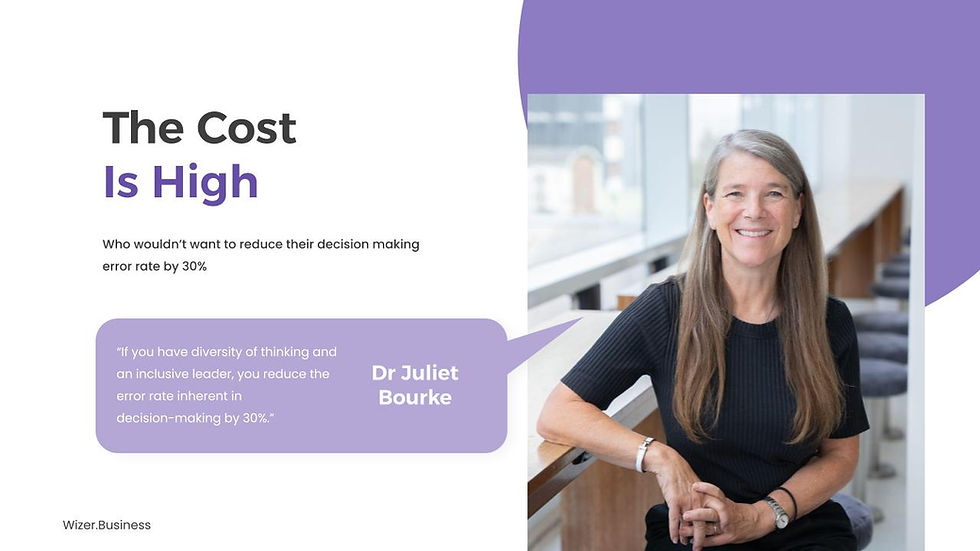
Research shows that organisations can cut decision errors by 30% and lift innovation outcomes by 20% when they structure decision-making the right way. Those gains are too big to ignore. They’re the difference between businesses that tread water and those that break through.
We saw it firsthand when the Sydney Children’s Hospital Foundation used Wizer’s "Greenlight Process" to open up opportunities across teams and fundraising. The result was extraordinary: paediatric research funding tripled. By widening the decision lens, connecting voices that hadn’t been heard before, and building trust in the process, the Foundation uncovered possibilities that had been hidden in plain sight.
That experience crystallised Wizer’s purpose. At its heart, Wizer exists to help people make better decisions. And when we say that — we mean addressing the structural forces that consistently distort how decisions get made.
Bias. Too many decisions are made by the same small group of people, who often replicate themselves. It isn’t malicious — it’s human bias. We’re wired to trust those who think like us. But without cognitive diversity, decisions narrow, blind spots grow, and opportunities vanish.
Conflict entrepreneurs. Look at the wider world: some of the biggest companies make their money by keeping people siloed and shouting at each other. It drives clicks, but it destroys trust. Organisations can’t afford that dynamic. They need the opposite — to break silos, surface talent, and build cultures that work across difference.
This is what Wizer is designed to do: create the right mix of voices for each decision. Diversity, cognitive diversity, and experience are the levers. With Decision Profiles, Panel Strength, and our Recommendation Engine, we give leaders a way to insource their people, prove to their boards why a decision is credible, and uncover the hidden talent already in their teams.
Better decisions aren’t an accident. They can be designed.
The Science Behind Better Decisions
If better decisions can be designed, the obvious question is: how?
The answer comes from decades of research. Dr Juliet Bourke’s work on diverse thinking frameworks showed that when leaders intentionally expand the perspectives in the room, the quality of decisions improves dramatically. Six different lenses — outcomes, options, people, process, evidence, and risk — create a far richer debate than the narrow focus most executives default to.

Layered on top of that is the “wisdom of crowds” effect. Under the right conditions — diversity, independence, decentralization, and aggregation — groups consistently outperform even their smartest individual members. The key is not just having more people, but the right mix of people, working independently and then brought together through a clear process.
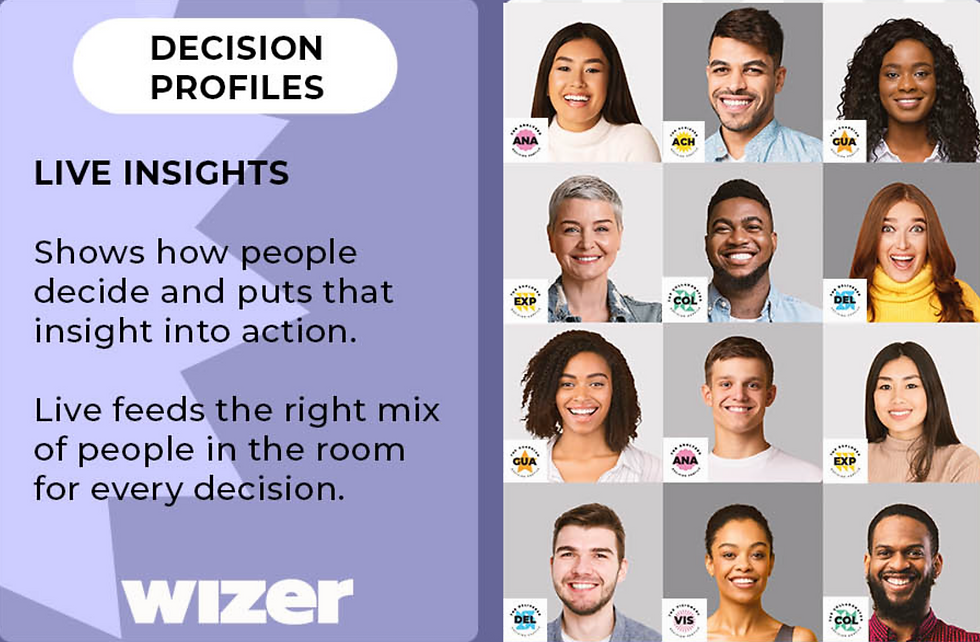
That insight drove us to build Wizer. We wanted to give organisations a practical way to apply the science — to move from theory to action. Over two years, we studied patterns of decision-making, ran pilots, and tested against real-world outcomes. The result was the creation of seven Decision Power Archetypes: Analyzer, Collaborator, Guardian, Explorer, Deliverer, Achiever, and Visionary.

Each archetype represents a distinct way of approaching problems, weighing evidence, and shaping solutions. On their own, they highlight individual strengths. Together, they reveal the cognitive diversity in a team — and, just as importantly, the gaps.
With these profiles, leaders can finally make the invisible visible. They can see not only who is in the room, but whose perspective is missing. They can predict where blind spots might emerge. And they can actively guard against cognitive drift — the natural tendency of organizations to narrow toward dominant ways of thinking over time. Profiles give leaders a way to design panels that are balanced, credible, and resilient to that drift. Profile Mapping & Team Optimisation
Most teams stop at personality tests or build out cumbersome frameworks. What they actually need is a living map of how their organisation makes decisions—and the ability to rebalance it in real time. That’s what Wizer delivers with our three unique points of difference coming together in one offering.
1) Decision Profiles (the living insight layer)
Our seven Decision Power Archetypes aren’t PDF reports; they’re a dynamic layer that updates as people join, leave, learn, and lead. Profiles connect to real work: projects, decisions, and rituals (kick-offs, risk reviews, steering groups). Over time, leaders see how styles show up under pressure, which combinations produce high-quality outcomes, and where the pattern tilts too far in one direction.
2) Panel Strength (visibility of balance, bias, and fit)
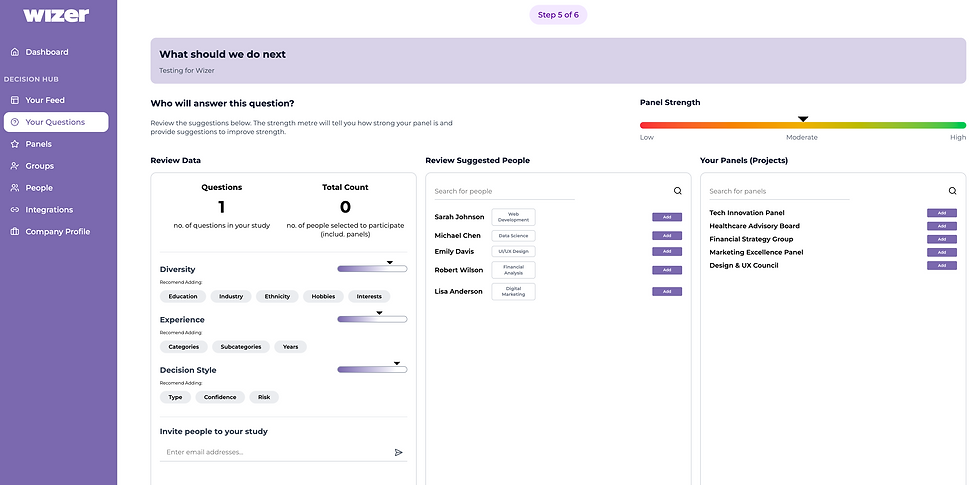
Panel Strength turns the abstract idea of “diverse thinking” into a score you can act on. It shows:
Archetype balance (e.g., too many Visionaries, not enough Deliverers).
Experience coverage - the most important piece (strategy & planning; creative & program design; execution & delivery; business & commercial; engagement & communication; policy & government).
Diversity signals (age spread, gender balance, indicators of homogeneity).
Leaders can run “what-if” scenarios—remove a person, add a voice, switch a panel’s purpose—and immediately see how the score and risk profile change. No more guessing. No more over-reliance on the same three people.
3) Recommendation Engine (who’s missing, exactly)
Once you can see imbalance, the next question is obvious: who should be in the room?The Recommendation Engine identifies specific people—often outside the usual orbit—who complete the mix for the decision at hand. In practice, 40–60% of recommended participants would not have been invited through normal channels. That’s how you surface hidden talent, reduce bias, and avoid slow, political selection processes.
What this looks like in the wild
A creative agency mapped its leadership and discovered a sea of Visionaries with almost no Deliverers. Strategy offsites were electric; execution lagged. Panel Strength made the gap undeniable; Recommendations named cross-functional Deliverers who could anchor delivery without killing momentum. Within a quarter, slippage reduced, handoffs improved, and ideas made it to market faster—with fewer U-turns.
Why this is infrastructure, not a workshop
Because it’s live, decision intelligence plugs into the system you already run: board papers (Greenlight traceability), portfolio gates, budget cycles, product councils, hiring loops. It shortens time-to-decision, increases option quality, and improves follow-through. Most importantly, it keeps your decision mix healthy—so you’re not rebuilding trust and process from scratch every quarter.
Stakeholder Engagement
When we first built Wizer, we thought of it as a tool for leaders and teams. What surprised us was how quickly clients began using it to tackle stakeholder engagement — one of the hardest, most credibility-sensitive tasks any organisation faces.
The reality is that most engagement processes are still run on spreadsheets and CRMs. They can track names, but they can’t tell you whether the right voices are represented, which groups are over-weighted, or who’s missing. Consultation often becomes a box-ticking exercise rather than a decision-shaping process.
Wizer changes that. By combining Decision Profiles, Panel Strength, and the Recommendation Engine, the platform gives organisations a way to:
Surface missing voices before questions are even asked.
Detect bias and over-representation so credibility isn’t undermined.
Balance panels in real time with recommendations that strengthen legitimacy.
One health organisation used Wizer to prepare for government reimbursement discussions. Instead of defaulting to the loudest or most obvious stakeholders, they built panels that included doctors, patients, and policymakers in the right proportions. The result was a process that was faster, more transparent, and far more credible than traditional consultation.
That’s the real advantage: clarity, credibility, and speed. Stakeholder engagement stops being a slow, political process and becomes an engine for trust. And when stakeholders trust the process, they’re far more likely to trust the outcomes.
What’s often overlooked is that even within a single stakeholder group — children, Indigenous communities, patients, employees — there is real cognitive diversity. One voice can’t stand in for the whole. Wizer makes it possible to surface that diversity and ensure it’s represented in the process. This moves engagement beyond token representation and into genuine insight, where different ways of thinking within the same community are visible and valued.
Wize Snaps
If stakeholder engagement shows the depth of Wizer, Snaps shows the speed.
Snaps began as a simple request from a fundraising team: could we use decision profiles to sharpen outreach messages? What started as an experiment quickly turned into a powerful communication tool.
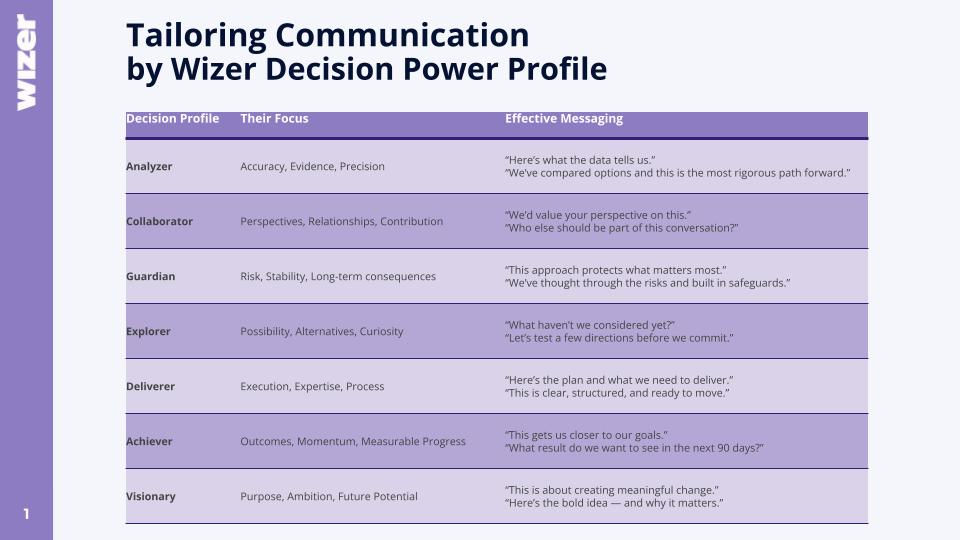
The principle is straightforward but transformative: one message doesn’t land the same way with all seven decision archetypes. A Visionary wants to know the big picture. A Deliverer wants to see the plan. A Guardian cares about risk. If you send the same words to everyone, half your audience tunes out.
Snaps rewrites your message to match the decision styles of the people you’re trying to reach. In under a minute, what was once generic becomes tailored. And when you use the right language for the right style, response rates jump. For fundraisers, that means stronger signals from their supporters. For marketers and sales teams, it means quicker clarity on what resonates.
The impact can feel deceptively small — just seven templates for communication. But the difference is profound. Snaps turns decision profiles from an internal map into an external lever. It proves that decision intelligence isn’t confined to boardrooms and strategy sessions; it belongs in everyday interactions.
Snaps may be the lightest touchpoint in the Wizer platform, but it demonstrates something profound: decision intelligence scales. The same insights that help a board design its strategy can also help a fundraiser write a sharper appeal, or a manager send a message that actually lands.
By making decision profiles actionable in day-to-day communication, Snaps proves that better decisions don’t just shape the big moments — they shape the small ones too.
Wizer to date
What we’ve learned so far has been transformative. From tripling research funding to strengthening stakeholder credibility, optimising how teams make decisions, and sharpening everyday communication, one pattern keeps repeating: when you design better decisions, you unlock better outcomes.
For us, this isn’t just about building software. It’s about building value for our clients — giving them tools to see bias before it distorts results, surface talent that would otherwise stay hidden, and make choices they can stand behind with confidence.
The pieces fit together:
Decision Profiles reveal the way people think.
Panel Strength shows when balance is missing.
The Recommendation Engine ensures the right people are in the room.
Snaps proves that the same intelligence works at the everyday level.
This is what decision intelligence looks like in practice — a living system that helps organisations move faster, think wider, and trust their process.
We’re excited about what’s next, but more than anything, we’re excited about what our clients are already achieving. The future of decision-making isn’t locked up in boardrooms or handed down by consultants. It’s being designed, tested, and proven every day — by organisations ready to insource their own intelligence.
If you want to see what this could look like inside your team, the best place to start is with a Decision Profile. From there, the possibilities expand.

