
Data-Driven Communications for Gender Equality: Create Messages That Get Heard
- Kylee Ingram
- Oct 18, 2025
- 5 min read

We keep circling the same debate while the numbers barely move. According to the World Economic Forum’s latest Global Gender Gap analysis, the world is 130 years away from parity if we continue at the current pace. Meanwhile in Australia, the average total-remuneration pay gap in the private sector is 21.8%, which works out to women taking home ~A$26,000 less per year.
The fix isn’t shouting louder. It’s designing how we communicate change so more people can say “yes” without heat.
What is Gender Compass—and why it matters
One of the clearest maps for audience segmentation in Australia is Plan International Australia’s Gender Compass. It’s a nationally representative study that surveyed 2,522 Australians aged 16+ in mid-2023 to understand attitudes, values, and behaviours on gender equality. The analysis clusters the public into six distinct segments that hear the same message very differently. In other words, there isn’t “one audience.” There are six.
The six segments (at a glance)
Trailblazer (19%) — deeply engaged; hopeful, impatient.
Hopeful (24%) — supportive, aware, optimistic.
Conflicted (12%) — equality matters, but “we’re nearly there.”
Moderate (23%) — mildly positive; other priorities often win.
Indifferent (6%) — low awareness and salience.
Rejector (17%) — believe change has gone too far.
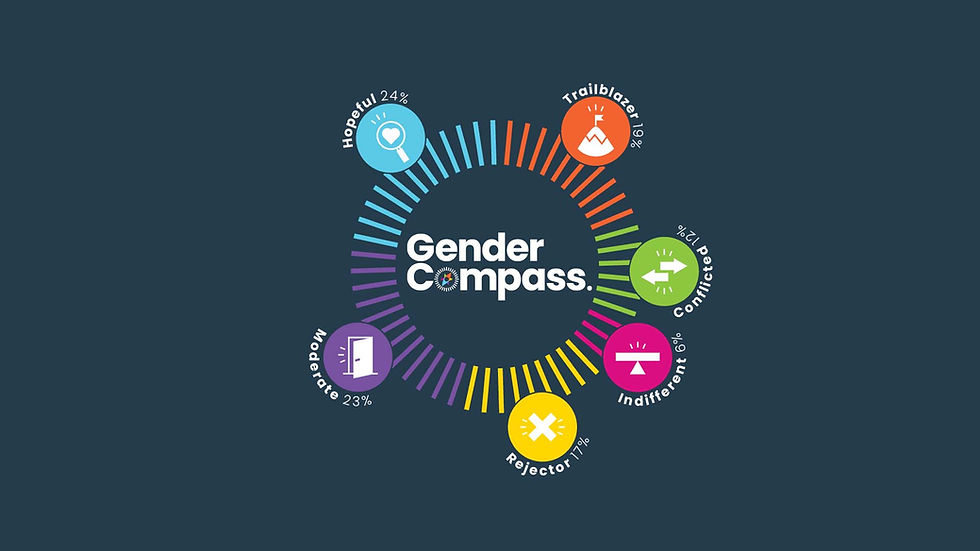
Plan Australia's Gender Compass
Treating everyone the same wastes effort—and can harden resistance. The opportunity is precision: adjust the frame, the story and the ask by segment.
Our Commitment (from Wizer)
We believe inclusion starts with being in the room when decisions are made. Bias shouldn’t keep the right people out. Wizer helps teams see who’s in the room, spot what’s missing, and fix it.
We have two tools that help on the journey to gender equality.
Tool 1: The Wizer Platform — three things that make it different
A decision platform for leaders to understand the talent in their teams.
Decision Profiles (free for individuals)Understand how people actually decide (Analyser, Achiever, Guardian, Deliverer, Visionary, Collaborator, Explorer). Use it to build balanced panels and avoid single-perspective decisions.
Panel StrengthA simple scorecard of the room: role mix, experience, diversity and decision styles. At a glance, you can see whether the panel is balanced enough to make a good call.
Recommendations (what’s missing)Clear, actionable suggestions to strengthen the panel before you decide—e.g., “Add frontline operations,” “Bring a Guardian,” “There are no women in your strategy sessions.”
Note on people & data: We capture the minimum needed, report patterns (not labels), and keep organisations in control of their data. When teams can see the gap, they usually self-correct.

Tool 2: Wize Snaps — comms that land
Getting the decision right is step one. Step two is making the message land. Wize Snaps is a lightweight tool that matches communication to people’s Decision Profiles—and now, with Gender Compass segments, it goes one step further.
Snaps does three things:
Creates a speculative Decision Profile for the person you’re writing to.
Makes recommendations on how to shape your message for that person.
Rewrites your communication in the right tone.

Now with the Gender Compass we will take it a step further. Add the segments to hit “Message Match.”
Pick your audience, understand what they value, and write to that. Pick your audience understand what they may value
Conflicted → fairness + near-term wins
Moderate → convenience + predictability
Indifferent → personal efficiency first; values second
Trailblazer → momentum + “scale what works” (celebrate a concrete win, name the next obstacle, make one specific ask)
Hopeful → practical ways to help + optimistic tone (benefit “for everyone,” one simple action this week)
Rejector → rules and merit; invite feedback; no moralising
Tune by Decision Profile (the sender’s style)
Analyzer → lead with the number and the method.
Achiever → target, KPI, recognition.
Guardian → safeguards, rule clarity, risk reduction.
Deliverer → steps, owners, dates—the path to done.
Visionary → future state and why it matters.
Collaborator → co-design and the feedback loop.
Explorer → reversible experiment and learning.

Data Driven Communication Decision Profiles and Audience Segments for Gender Equity
Snaps-ready copy blocks (examples)
Conflicted × Guardian — Fair rule, one cycle We’re close but not there. Last quarter, women were 32% of shortlists; we’re aiming for 40% to choose from stronger fields. If a shortlist isn’t balanced, we widen the net by one candidate before interviews. No shortcuts—just a clear rule. We’ll run this for one hiring round and publish results. If quality improves, we keep it.
Moderate × Deliverer — Fewer hassles, more predictability
The handover checklist takes two minutes and cuts next-day follow-ups. Try it for one month. Three checks, supervisor sign-off, opt out anytime. We’ll track missed handovers and late finishes.
Indifferent × Analyzer — Time saved first; values second
Defaulting to the handover checklist saves ~6 minutes per shift. Switch off anytime. Side effect: faster onboarding for new team members.
Trailblazer × Visionary — Scale what works
Two pilots closed small gaps this quarter—flexible rostering in A, transparent criteria in B. Next: scale to two more sites and mentor new leads. Four-week sprint, one hour a week.
Hopeful × Collaborator — Help shape the next version
We’re standardising interview criteria so every role runs the same way. Join a 30-minute co-design session to road-test the draft, catch blind spots, and agree how we’ll publish results.
Rejector × Guardian — Rules protect merit; feedback welcome We’re clarifying how shortlists are built—same criteria for every role, with an audit trail. This protects merit and reduces disputes. Read the one-pager and tell us what doesn’t work in your context. We’ll keep what improves quality and fairness.
Guardrails that prevent backlash (and keep momentum)
Lead with rules and results, not identity.
Make every change time-boxed.
Track one outcome and publish it on a set date.
If a message raises heat without moving the metric, replace it.
Where Wizer fits
The platform surfaces patterns without confrontation—who’s in the room, where it skews, what repeats. That’s data telling the story. https://www.wizer.business/use-cases
Snaps turns those facts into segment-smart, style-tuned messages you can drop into email, Slack/Teams, or your intranet in minutes. https://www.wizer.business/commsmatching
Use the data to pick the right door. Use the message to help people walk through it.
Close: Progress beats posture
We won’t close a 130-year gap by arguing harder. We’ll close it faster by designing smarter: let the numbers set the tone, then deliver messages that get heard—especially by the people most likely to move now. And while the national pay-gap figure is a sobering headline, it’s also a compass. We are keen to help shape the journey using live data and recommendations Feel free to try Wize Snaps here. Download the Snaps profile prompt cheat-sheet → The prompts to ensure you get the right decision profile. Download the Snaps Gender Compass prompt cheat-sheet → A one-liner to paste above your message so the draft lands first time.


