Biology of Deciding Together: Why Humans Decide Better in Groups
- Kylee Ingram
- Oct 24, 2025
- 9 min read

Humans didn’t evolve to decide in isolation. The biology of deciding together shows our brains expect other people in the loop. With this said many organisations still run decisions like solo sports—find the smartest person, give them the data, then ask them to call it. Biology tells a different story. Human cognition, stress systems, and communication circuits assume other people are in the loop. We are built to coordinate, compare perspectives, check one another’s blind spots, and—when it’s designed well—arrive at better answers than any one of us can manage alone.
This isn’t about collaboration for its own sake. It’s an argument from evidence: the traits that make us human are the traits that make decisions stronger in groups. The trick is structuring those groups so the biology works for you, not against you. There is no need for decision groups to be random or to let a few people decide who should be in the room. We can leave that to science.
Under the right conditions—diversity, independence, decentralised knowledge, and smart aggregation—groups often outperform individuals. We’ll come back to this as the ‘wisdom of crowds’ and, crucially, including when it fails.

1) The brain that grew for people
Humans didn’t get big brains only to whittle spears or balance spreadsheets. Our cortex scaled with the complexity of our social networks. That is the essence of the “social brain” hypothesis: across primates, neocortex volume tracks typical group size, and for humans it predicts a layered social world of circles and sub-circles we can meaningfully maintain. In other words, the brain evolved for managing people problems—coalitions, trust, gossip, reputation—not hermit-style calculation. It’s why so much of daily thought is spent anticipating others, simulating their reactions, and aligning with them. Designing decisions as if they were a purely private act ignores what those brains are good at. Annals of Human Biology (Dunbar)
2) The social brain behind the biology of deciding together
Even among social primates, humans are good at a very specific trick: shared goals. Michael Tomasello calls it “shared intentionality”—the capacity to form genuinely joint aims, divide roles, coordinate attention, and transmit culture across generations. Small children show it long before they can do anything like formal reasoning; they point to help, not to boast. That “we-mode” sits underneath teamwork and, crucially, underneath durable decision-making: decisions that stick because everyone understands not only the outcome, but the shared purpose and roles that got them there. Groups that perform well tend to make this explicit early—why this decision, why now, what does “good” mean here, what is in and out of scope—because the human engine is built to lock on to joint intent.
3) Together lowers the load
There’s also a metabolic story. Social Baseline Theory frames social connection as the default human ecology: the nervous system expects proximity to familiar others. Put simply, when you’re with trusted people, threat feels smaller and goals feel nearer; the brain spends less energy regulating emotion and more on the task. Leaders often retreat to make “the big call” alone; biology suggests the opposite. When pressure is high, pairing decisions with a small, trusted group reduces cognitive strain and improves follow-through. This isn’t sentiment—it’s energetics.
4) Conversation that literally couples brains
If that sounds soft, here’s the hard neural correlate. In effective conversation, patterns of brain activity in speakers and listeners lock together. The better the alignment, the better the understanding of the story; in fact, listeners show anticipatory coupling—tracking where the speaker is going before they get there. Communication isn’t just moving words through air; it’s synchronising predictive models across heads. Good decision meetings manufacture that synchrony with short, specific messages, clear pre-reads, and a rhythm that lets people align before they argue. PNAS
5) Measuring the “smarts” of groups
What predicts a team’s performance across tasks? Not the average IQ. Anita Woolley and colleagues showed that group effectiveness is captured by a measurable “collective intelligence” factor (c-factor) driven by three things: social sensitivity, balanced turn-taking, and (in their samples) a higher proportion of women—likely because, on average, women scored higher on social sensitivity. The point isn’t identity politics; it’s mechanics. Groups that attend to each other well, and share airtime evenly, produce better results across very different challenges. Decision rituals that force equal rounds, ask the quiet expert first, and rotate the chair are not “nice to haves”; they raise the c-factor.
6) What the biology of group decision-making predicts about diversity
Diversity can be framed as ethics or optics. In complex problem-solving, it is also maths. Scott Page and Lu Hong formalised a result that surprised many managers: groups of cognitively diverse problem-solvers can outperform more “able” but homogeneous groups, because they bring different heuristics to search a larger solution space. There are boundary conditions, and the literature has matured with critiques and clarifications, but the core insight survives: when the landscape is rugged and the answer is not obvious, different ways of seeing beat a line-up of near-clones. That is less about background categories than about variety in approaches—model-builders, pattern-spotters, contrarians, simplifiers—deliberately assembled.
7) The wisdom (and fragility) of majorities
The dream of “more heads are better” has a clean theorem behind it. Condorcet’s Jury Theorem says that, if individual judgments are independent and each is slightly better than chance, aggregating many of them through majority vote drives the probability of a correct decision towards 1. Add heads, rise accuracy. But the assumptions matter. Break independence through strong social influence, or include many poorly informed voices, and the benefit erodes. Modern treatments refine those conditions; the upshot for leaders is practical: collect inputs in parallel before discussion, keep early rounds anonymous when possible, and only then deliberate. Design to protect independence first, aggregation second, persuasion last.
Limits: when the biology of group decision-making can mislead
Wisdom of Crowds — when it works (and when it breaks)
The crowd can be remarkably accurate—but only under a few conditions. Surowiecki’s synthesis points to four: diversity of opinion, independence of judgments, decentralisation of knowledge, and a clear aggregation method. When those hold, the average can outperform most individuals (Galton’s classic ox-weight demo is the illustration). Break independence with social influence and the advantage collapses: estimates converge, diversity shrinks, confidence rises, accuracy falls. The takeaway isn’t “more people = better decisions.” It’s design for diversity and independence first, then aggregate well.
Design rules implied by the biology of deciding together
If the case for group decisions rests on how our brains and social systems actually work, the challenge is building processes that respect that biology. A few principles come up again and again in the research—and in the rooms where decisions hold.
Start with shared intent. Decisions wobble when the “we” is vague. Before options, articulate purpose: Why this decision? Why now? What does “good” look like? What’s out of scope? Tomasello’s work suggests humans are astonishingly ready to cooperate when a joint goal is clear; teams that rush the brief pay later in rework and alignment tax.
Sequence for independence, then influence. The Condorcet logic is fragile. Preserve independence by capturing first impressions or ratings in parallel, before the most senior or most fluent person speaks. Use simple mechanisms: a two-minute silent round; index cards; a fast form (or use Wizer is it designed for independence :-). Then show the distribution without names. Only after that do you debate. You’re not killing discussion—you’re protecting its value.
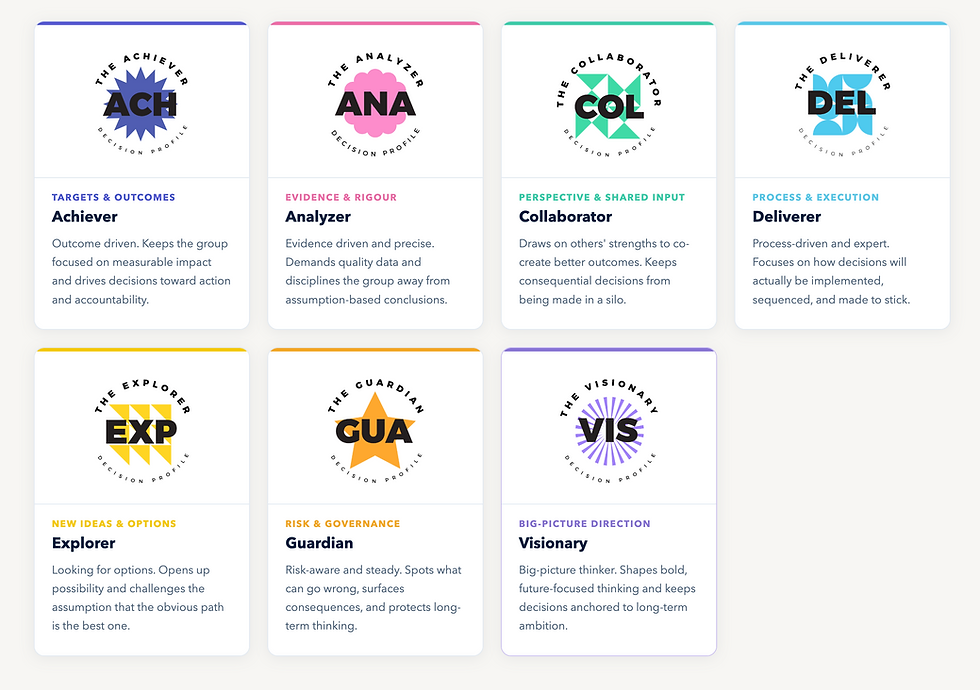
Curate cognitive variety on purpose. Don’t confuse diversity with headcount. You need people who naturally optimise different parts of the problem: evidence, options, outcomes, risk, process, and people effects. Page and Hong’s result worked because the solvers approached landscapes differently; if everyone is trained in the same school and rewarded for the same moves, you’ve shrunk your search space before you start. Invite a counter-style deliberately and make it safe to be out of tune.
Engineer turn-taking and sensitivity. The c-factor research is uncomfortable for leaders who equate “decisive” with “dominating.” Social sensitivity and balanced airtime predicted performance across tasks far better than raw IQ. That’s not an attack on intelligence; it’s a map of where intelligence shows up in groups. Use rounds. Track who speaks. Ask, “What’s the strongest argument against our current favourite?” Facilitation is not decoration—it’s how the group’s intelligence becomes real.
Exploit synchrony. If communication literally aligns neural activity, then design for alignment before persuasion. Send a one-page pre-read. Start the meeting by paraphrasing the problem until everyone can say it back. Ban new data drops mid-meeting unless everyone gets time to absorb them. You’re not slowing down; you’re reducing error introduced by mis-alignment.
Use trust to lower cognitive load. High-stakes choices shouldn’t be lonely. SBT suggests that having the right people close doesn’t just feel better; it changes the effort required to act. If you want courage and clarity from decision-makers, design small, trusted decision pods for the most pressured calls.
Name the trade and close well. “Group decision” shouldn’t be code for endless process. Good groups close with roles and reasons: who owns the decision and why this choice beat the alternatives. Stating the rationale out loud helps everyone rehearse the story they will tell others; it’s also a psychological commitment device that stabilises action.
Common traps (and how to avoid them)
The charisma anchor. Charismatic, fast thinkers are a gift when they’re right and a hazard when they set the frame too early. The fix is structural: independent inputs first, then facilitation that draws out the non-fluents.
Diversity as decoration. Adding different faces to a table without changing process is theatre. Cognitive variety must show up in who speaks, what evidence is valued, and how options are generated. Page and Hong’s advantage emerges when different heuristics are allowed to compete, not when dissent is nodded at and ignored.
Data as a substitute for design. More dashboards rarely solve a room designed for sameness. The social brain evidence is blunt: if you ignore the human layer—relationships, status, trust—you’ve put the data on the wrong scaffold.
Speed without rhythm. Urgency is often real; so is the cost of skipping alignment and independence. Build a fast cadence that still protects the sequence: intent → independent inputs → transparent aggregation → live debate → clear ownership. Short cycles, not shallow ones.
Why this matters now
Two features of the current environment make biological design for decisions more, not less, important.
First, the problems are messier. Climate, technology, public trust, and geopolitical shocks create landscapes where no single heuristic dominates for long. In rugged terrain, variety beats uniform ability; you need teams that can switch lenses under pressure, not just run last year’s playbook harder.
Second, the channels are noisier. Remote work, asynchronous tools, and a flood of AI-mediated communication raise the risk of misalignment even as they increase reach. The neural-coupling studies are a reminder that communication is an embodied skill, not simply transmission. The teams that win will be the ones that engineer synchrony quickly and often, then protect independent thought before the chorus begins.
This is not a romantic argument for endless consensus. It’s a pragmatic claim: when we respect what humans are—hyper-social brains tuned for joint goals, regulated by proximity and trust, capable of literal neural alignment in conversation—we make better decisions together. The failure mode is not “too many people”; it is the wrong people, in the wrong order, with the wrong signals.
Get the order right. Invite difference on purpose. Protect independence. Share the airtime. Close with clarity. That’s not a management fad. It’s biology, doing what it evolved to do.
References & further reading
R. I. M. Dunbar, “The social brain hypothesis – thirty years on,” Annals of Human Biology (2024). Review of the primate neocortex–group size relationship and its implications for human social layers.
“The Social Brain: Psychological Underpinnings and Implications for the Social World,” Philosophical Transactions of the Royal Society B overview via JSTOR. Predicts typical human group sizes and layered networks. JSTOR
Michael Tomasello et al., “Understanding and sharing intentions: The origins of cultural cognition,” Behavioral and Brain Sciences (2005). Foundational account of shared intentionality and the human “we-mode.”
James A. Coan, Lane Beckes et al., “Social Baseline Theory: State of the Science,” Current Opinion in Psychology (2021); and Coan et al., “Social Baseline Theory and the Social Regulation of Emotion.” Social proximity reduces perceived risk and energetic cost.
Gregory J. Stephens, Lauren J. Silbert, Uri Hasson, “Speaker–listener neural coupling underlies successful communication,” PNAS (2010). Neural synchrony predicts comprehension. PNAS
Anita W. Woolley et al., “Evidence for a Collective Intelligence Factor in the Performance of Human Groups,” Science (2010); plus supplementary materials on social sensitivity and turn-taking.
Lu Hong & Scott E. Page, “Groups of diverse problem solvers can outperform groups of high-ability problem solvers,” PNAS (2004); with discussion of boundary conditions and subsequent commentary.
Condorcet’s Jury Theorem—overview and modern critiques on independence and competence assumptions.
James Surowiecki, The Wisdom of Crowds (2004) — four conditions: diversity, independence, decentralization, aggregation.
Francis Galton, “Vox Populi” — median crowd estimate within 0.8% of an ox’s true weight.
Jan Lorenz et al., “How social influence can undermine the wisdom of crowd effect” (PNAS, 2011) — social influence narrows range and reduces accuracy.
(Nice add) Andrea Van Bavel et al., “Enhancing the Wisdom of the Crowd With Cognitive-Process Diversity” (Psychological Science, 2020) — mixing intuitive + analytical judges improves aggregated accuracy. SAGE Journals