
Challenger at Forty: How Decision Failure Actually Happens
- Kylee Ingram
- Feb 16
- 7 min read

Revisiting the Challenger disaster alongside the Columbia investigation shifts the focus away from rockets and materials science and back into the room where the decisions were made. I’ve been listening to The Challenger Legacy series on ABC recently, revisiting the Challenger disaster alongside the Columbia investigation. It is rocket science it is so important to have experts in the room but in both cases it was the decision room that lead to the deaths of all of these astronauts.
The imagery of launch and breakup is unforgettable, but what ultimately determines whether those images exist is something quieter: the tone of a meeting, the structure of authority, and the way uncertainty is handled when pressure is present.
Both disasters are extensively documented. Challenger in 1986 and Columbia in 2003. Seventeen years apart, different vehicles, different technical mechanisms. Yet when the transcripts and investigative reports are read carefully, the decision dynamics look disturbingly familiar.
Before the Challenger launched in unusually cold conditions, engineers expressed clear concerns about O-ring performance at low temperatures. They recommended not launching below a defined threshold. The issue was debated. A management caucus took place. The framing shifted from engineering assessment to managerial judgement. The recommendation changed. The launch proceeded.
In Columbia’s case, foam strikes were not an unknown phenomenon. Debris shedding had been observed on prior flights. The organisation had come to regard it as manageable. After launch, engineers requested imagery to assess potential wing damage. The request did not gain the traction it required. Leadership leaned toward reassurance. The mission continued as planned. The shuttle broke apart on re-entry.
Once the technical details are stripped back, what remains is not ignorance or incompetence. It is the way organisations interpret risk when continuation is easier than interruption. By the time each launch occurred, the system had already adjusted its understanding of what was acceptable.

The Challenger Disaster and Decision Failure - Drift rarely announces itself
“Normalisation of deviance” is often used to describe this pattern, and the phrase is useful, but it can obscure how gradual the shift really is. In Challenger’s case, O-ring erosion and blow-by had been observed on earlier flights. The vehicles returned safely. Over time, what began as a deviation from design expectation became part of operational experience. The absence of catastrophe was interpreted as evidence of sufficient margin.
Columbia followed a similar trajectory. Foam shedding from the external tank had occurred before without catastrophic consequence. The anomaly was absorbed into routine understanding.
From Challenger decision failure and beyond - inside the system, drift does not feel reckless. Each decision has a rationale. Each meeting produces arguments that make sense in context. Risk is negotiated step by step, often in the presence of incomplete data. The organisation experiences continuity, not crisis.
The engineers did speak
It is convenient to describe Challenger as a communication failure, but the record does not support that simplification. Engineers presented their data. They articulated concern about low-temperature performance and sealing response time. Their position was documented.
What changed was not the existence of information but its authority.
When discussion moved from engineering analysis to management framing, the burden shifted. Instead of asking whether conditions were demonstrably safe, the conversation increasingly revolved around whether there was conclusive evidence that they were unsafe. That distinction appears subtle, yet it has structural consequences. If proof of danger becomes the standard, ambiguity tends to resolve toward action.
The context matters. NASA in the 1980s was operating under political and budgetary pressure. The shuttle programme had been positioned as reusable and increasingly routine. Launch cadence, public visibility, and institutional reputation were real considerations. None of those pressures needed to be malicious to shape interpretation. They formed the atmosphere in which judgement was exercised.
The same interpretive dynamic surfaced before Columbia. Foam strikes were known. The engineering community understood the mechanism. Yet the organisation had grown accustomed to managing it. When post-launch concerns were raised, they were filtered through an established belief that foam had not previously destroyed a vehicle. The request for additional imagery did not override that belief. Again, ambiguity resolved in favour of continuity.
The pattern is procedural rather than dramatic.
Leadership and cultural weight
Hierarchy played a decisive role in both cases. Social bias in decision-making is less about overt prejudice and more about whose interpretation carries weight when there is disagreement. Seniority, positional authority, historical influence, and confidence shape how arguments are received.
Engineers in Utah expressed strong reservations prior to Challenger’s launch. Senior contractor management revised the recommendation after internal deliberation. NASA managers interpreted the final position as consensus. The dissent did not survive intact as it moved up the hierarchy.
Columbia’s investigation later described similar authority gradients. Engineers raising concerns about possible wing damage were unable to elevate those concerns into decisive action. Requests for further analysis did not gain urgency in the chain of command.
When authority is concentrated and escalation pathways are weak, dissent must work harder to endure. In high-pressure environments, that endurance is rarely guaranteed.
Information bias under pressure
Information bias operates alongside social bias. It shapes how data is weighted when evidence is incomplete.
In Challenger’s case, the correlation between temperature and damage was not perfectly linear or statistically decisive. That ambiguity became a hinge. Rather than treating incomplete correlation as a reason for conservatism outside validated conditions, it was treated as insufficient proof of catastrophe.
In Columbia’s case, prior foam strikes without catastrophic consequence formed a cognitive anchor. Evidence that supported continuity felt stabilising; evidence that threatened it was subjected to more scrutiny.
Human judgement under pressure naturally seeks coherence. When continuation aligns with institutional goals and past experience, ambiguous signals are more likely to be interpreted as tolerable risk rather than structural threat.
A structural lens
Viewed through a structural decision lens, both disasters share identifiable characteristics:
Decision authority concentrated at the top of the hierarchy
Weak mechanisms to preserve and elevate dissenting technical judgement
External stakeholder and schedule pressure embedded in the context
Historical anomalies reframed as manageable within shifting boundaries
Ambiguous evidence resolved toward continuation
These dynamics are not unique to aerospace. They appear in corporate boards, regulatory decisions, financial institutions, healthcare systems, and product organisations. The shuttle cases endure because they are unusually transparent; the documentation allows the internal logic to be reconstructed in detail. In most organisational failures, that internal reasoning remains opaque.
Modelling the authority cluster
To test whether this pattern was anecdotal or structural, the primary decision authority group involved in the January 27 Challenger teleconference was modelled using Wize Snaps, based on documented testimony, communication tone and decision framing patterns.

The cluster included five NASA program authorities and three senior Morton Thiokol executives whose acceptance determined whether the launch would proceed.
The resulting profile distribution was heavily weighted toward operational execution instincts. Three Deliverer profiles formed the core, alongside two Analyzers. A single Guardian and one Collaborator were present. There were no Explorer or Visionary profiles within the authority cluster.

Rooms dominated by execution-oriented instincts tend to resolve ambiguity toward forward motion. Analytical profiles may test internal logic, but without strong boundary-enforcement or reframing energy, the conversation can shift from whether to proceed to how to justify proceeding.
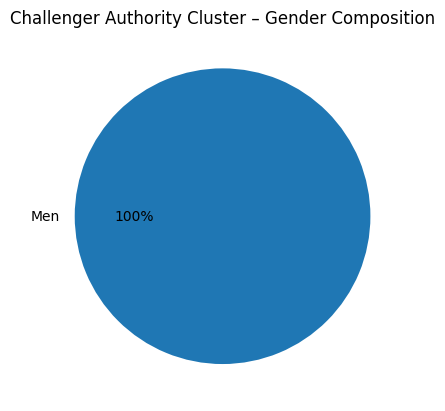
The authority group was also demographically homogeneous, reflecting the leadership composition of the era. Research across decision science consistently shows that homogeneous authority clusters tend to exhibit higher confidence convergence and reduced dissent persistence under pressure.
The modelling does not suggest recklessness. It highlights imbalance.
Structural imbalance makes certain outcomes more likely, particularly when uncertainty intersects with schedule pressure. We also know having a homogenized group of any kind - gender - culturally or age ; leads to decision errors.
Cultural composition of the room
Every leadership team develops a cultural profile. Some teams lean toward execution and delivery. Others orient around commercial viability, stakeholder management, or political navigation. Others prioritise technical integrity and boundary enforcement.
None of these orientations are inherently flawed. Problems emerge when one dominates without counterbalance. If a leadership culture heavily privileges momentum and external expectation, voices focused on constraint and system integrity may be perceived as obstructive. Over time, that perception influences how often those voices speak and how forcefully they are heard.
In the shuttle era, the organisational culture had grown accustomed to negotiating risk in order to maintain continuity. Previous successful launches reinforced confidence in the system’s resilience. The balance between ambition and boundary gradually shifted.
Structural balance matters more than individual brilliance. A room composed primarily of forward-driving instincts will interpret ambiguity differently than one that gives equal weight to containment and constraint.
Pressure does not excuse structure
It is tempting to assume that hindsight makes these decisions obvious. Inside the system, the pressures were constant and complex. NASA faced budget scrutiny, political oversight, and public expectation. In 2003, the shuttle fleet was ageing and resources were finite. Leaders operate within institutional narratives that define what feels urgent and what feels deferrable.
The deeper issue is not that pressure existed, but that the decision structure did not compensate for it. When organisations face sustained pressure, they require stronger mechanisms to protect dissent and enforce boundary conditions, not weaker ones.
Returning to the Moon
Nearly fifty years after the last Apollo mission and forty years after Challenger, NASA is preparing to send astronauts back to the Moon through the Artemis program. The technical ambition is extraordinary. The question is whether the cultural and decision architecture has evolved at the same pace.
Space exploration has always involved risk. The issue is not whether risk exists, but how it is governed when uncertainty appears under pressure.
Are engineering concerns institutionally protected when they challenge schedule?Is the burden of proof aligned toward demonstrating safety outside validated conditions?Are authority gradients actively counterbalanced in mission-critical decisions?Is the leadership cluster culturally balanced, or does forward momentum dominate boundary enforcement?
The legacy of Challenger and Columbia is not a warning about exploration. It is a reminder that leadership culture determines how exploration is governed. When decision authority becomes homogeneous and ambiguity resolves toward continuation, drift becomes more likely.
Returning to the Moon will test whether institutional design has strengthened alongside technical capability.
Preventing drift requires deliberate architecture. It requires structures that protect dissent, redistribute authority when necessary, and maintain cultural balance under pressure.
Absent that design, even highly capable institutions can persuade themselves that continuation is reasonable until it is not. Ensure you design your decision rooms well. Start with Decision Profile Mapping


